


An uncomfortable witness
The American journalist Theo Padnos, kidnapped in 2012, recounts in Rolling Stone his captivity in the infamous “eye hospital” of Aleppo, turned into a headquarters and torture center under al-Shara’s control. There, according to his testimony:
“The commanders hung the prisoners from the ceiling pipes, connected battery cables to their limbs, forced them to confess that they hated Islam and worked for the CIA. (…) ‘You’ve been lying every moment of your life,’ they shouted before beating them. The scream was inhuman, and they always ended with a warning: ‘Get ready, because this is just the beginning’”
(Rolling Stone, 28/09/2025).
Padnos remembers that his jailer was Ahmed al-Shara, today’s president, whom he describes as the “coldest and most calculating of the commanders” in the place.
The international whitewash
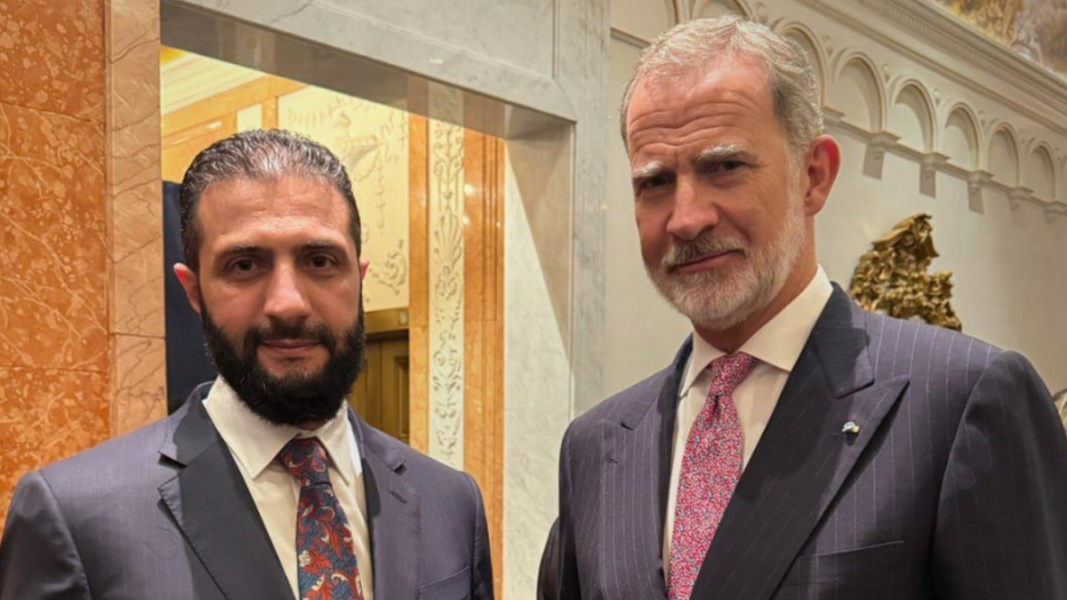
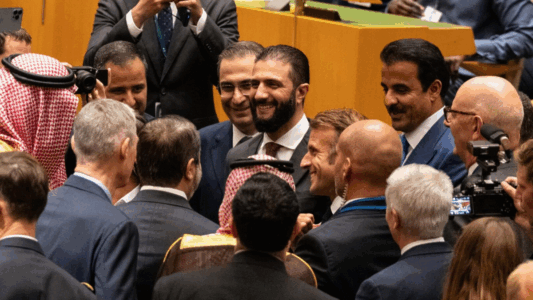
Despite this past, the international community has thrown open the doors wide to al-Shara. The terrorist (now suited up) has been received at the UN “with honors of a head of state,” has met with Trump and high-ranking Western officials, and has even been seen wearing a Patek Philippe watch worth $50,000.
The contrast between the “modern statesman” and the jailer who ordered executions is unbearable.
Israel and the West, accomplices
Al-Shara’s rise also cannot be understood without international complicity. While Israel provided indirect military support during the offensive that ended up expelling Bashar al-Assad last December, European weaponry abounded among the jihadists. The West rushed to lift sanctions and seat Bin Laden’s disciple at the negotiating table.
Meanwhile, the reality in Syria remains bloody. A Reuters (30/06/2025) investigation revealed that in March 1,500 Alawites were massacred on the Mediterranean coast under the chain of command of the new government. In July, the Syrian Observatory for Human Rights denounced the execution of more than 1,100 Druze in Sweida.
Amid this scenario of violence and political manipulation, Christian communities in Syria continue to suffer. The Middle East Council of Churches (MECC) firmly denounced the attack on the Church of Saint Elias, near Damascus, which left dead and wounded among the faithful. Church leaders demanded that the new Syrian authorities “act decisively” to identify and punish the culprits, while calling for real security guarantees.
The Archbishop of Homs, Jacques Mourad has described the country’s situation with rawness: “the people live without dignity or trust.” Although it cannot always be spoken of as organized persecution against Christians, he explains, the general feeling is one of insecurity and abandonment, and many families try to emigrate to survive. His words highlight the contradiction between the image of stability that al-Shara’s regime wants to project in the West and the reality suffered by local communities, trapped between economic misery, threats from extremist groups, and the indifference of those who, from outside, legitimize the new power.
An inverted narrative
Theo Padnos himself, after two years in cells and basements, concludes:
“My captors preferred their fictions to the real world. In those candlelit rooms, everything seemed possible: the blood was real, the pain was real, and for them it was divine justice”
(Rolling Stone, 28/09/2025).
That is the man who today presents himself in New York as a guarantor of peace and modernity, while the international press avoids recalling his past.
Who is directing the campaign?
The most serious issue is not only al-Shara’s track record, but the coordinated whitewashing operation that accompanies it. Israeli support, smiles from Western leaders, and uncritical media coverage configure an unprecedented public relations operation.
Discovering what interests and what communication firms are behind this campaign would be essential to understanding how a jihadist leader has been turned into a legitimate president in the eyes of the world.