


By: Monsignor Alberto José González Chaves
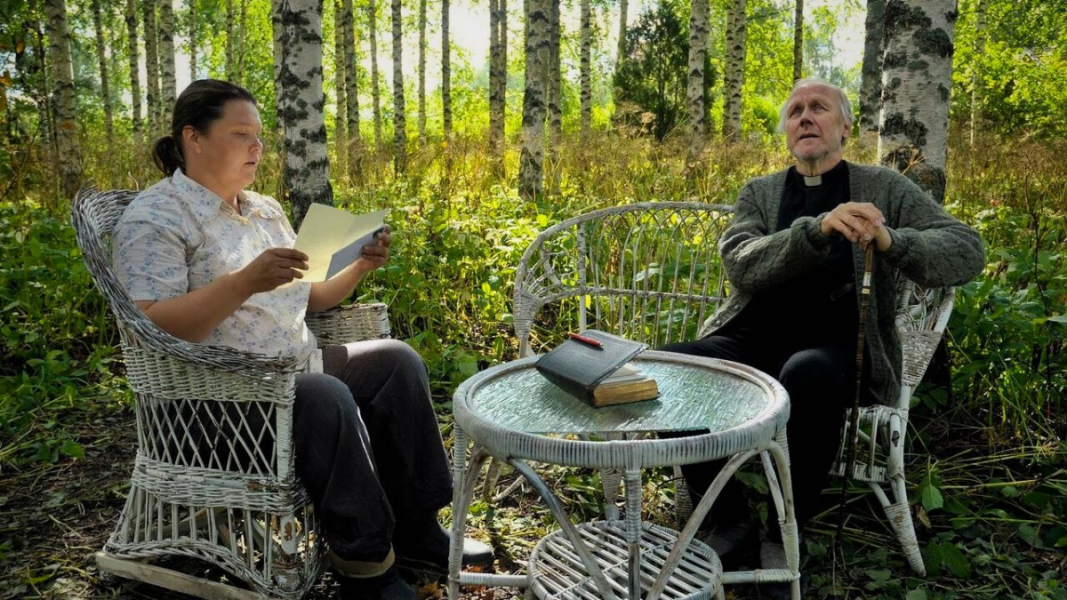
There are films that, without boasting a large budget or artifices, glide with the delicacy of a whispered prayer. “Letters to Father Jacob” (original: Postia pappi Jaakobille), by the Finnish director Klaus Härö, is one of those silent jewels that touch the soul with the humility of what is true. It is a slow, dense film, sometimes too intense due to its unhurried pace and profound content, inviting the viewer to serene reflection. The careful photography and light, delicately crafted, as well as the very notable performances of its two protagonists—Heikki Nousiainen as Father Jacob and Kaarina Hazard as Leila—endow the film with an intimate and recollected atmosphere, almost monastic.
The entire story unfolds in an old rural rectory, austere and simple, where Father Jacob lives alone, accompanied only by the whisper of the wind among the trees and the letters he receives day after day from troubled souls, which he piles up neatly under his bed in incredible quantities. That silence is space for the soul, for encounter with God and with human miseries. As a priest, I cannot help but see in that place the image of so many parishes today: silent, impoverished, forgotten, where the priest’s presence is not measured in quantity, but in fidelity and dedication.
On the rectory table, discreet and bare, there is a loaf of bread with a knife, always ready to be used to cut it. It is a silent and deeply symbolic detail: that bread is the priest himself, offered to be broken and to satisfy the hunger of others. The knife, at its side, is the cross that marks his surrender. That bread, always covered by a white napkin—like an Eucharistic veil or canopy that veils the humility of the Presence—reminds us that all altars are equal, because they are all the one altar: the Heart of Jesus Christ, priest, altar, and victim.
The film does not explicitly define Father Jacob’s confessional identity: being Finnish, he should presumably be Lutheran, but in his home, a white image of Mary and several crucifixes are always very visible. Could he not even be seen as a Catholic priest..? In any case, the profound value of intercession and even priestly co-redemption is clearly highlighted, and this is eminently Catholic. In a particularly significant scene, Father Jacob, alone in the church and without sacred vestments, drinks from a chalice, as if intimately uniting himself to Christ’s redemptive sacrifice. There are no grand ceremonies or solemnities, but that simple gesture conveys the entire depth of the priesthood: union with the redemptive mystery, quiet and silent surrender.
In another striking scene, Father Jacob proclaims aloud, alone, in a dilapidated and empty church, the hymn to charity from the first epistle of Saint Paul to the Corinthians: “If I have no charity, I am nothing.” His voice, already weakened by age, echoes like a slow and beautiful resonance, without response or audience, but with a force that goes beyond physical solitude: it is a proclamation to the world that needs to rediscover true love.
Throughout the film, the total absence of visible parishioners stands out; the recipients of Father Jacob’s ministry are the souls who write to him in letters, but who never appear on screen. This invisibility reflects the reality of a priesthood often silent, that acts in the intimacy of the human heart and in the discretion of suffering.
The arrival of Leila, a tough woman marked by life, a pardoned ex-convict from a life sentence who comes to the rectory to fulfill a civil service, provides a decisive and hope-filled counterpoint. The relationship that gradually weaves between her and Father Jacob forms the backbone of the narrative and is a moving mirror of priestly life: the priest who welcomes, waits, prays, and forgives, even without being reciprocated or valued.
The postman, played by Esko Roine, represents the gaze of the man who judges without mercy, who starts from prejudices and does not reflect the compassionate heart of Jesus. He is a reminder that the priest’s path also passes through misunderstanding and solitude before those who do not understand the tenderness or the mission of the shepherd.
In a deeply human moment, Father Jacob confesses to Leila, almost defeated, that people have stopped writing to him: “If people don’t ask me for help, it means God no longer entrusts me with any mission.” And upon realizing that no one has come to the ceremony—not knowing if it was a wedding or a baptism—he murmurs sadly: “Who needs an old and sick shepherd? No one.” It is a confession of loneliness and discouragement that reflects the fragility of every human mission.
In a slow and intense scene, Leila gets into a taxi to leave, but her face changes; we do not see her get out, but in the next instant, we find her back at the rectory with the suitcase in hand, returning to Father Jacob. It is as if a mysterious light of grace had touched a hardened and closed heart, illuminating the path of return. This scene summarizes the patience and hope of divine mercy, which does not impose itself but whispers and accompanies.
Almost at the end, Leila, now surrendered to the process of conversion, reads an imaginary letter before Father Jacob that is nothing but the narration of her own autobiography. With a broken voice, she recounts her life marked by wounds and desperations while the priest listens with tenderness and silence. This moment is not only a confession but an act of surrender that shows the healing action of grace in the broken soul. For Jacob, it is the living testimony of the divine force that acts amid human fragility.
Afterward, Leila receives a bundle of letters from Father Jacob’s hands. They are from her sister. She begins to read one of them aloud, not yet knowing the depth of the gift she is about to receive. The letter, addressed to the priest, begs him not to abandon Leila if their paths ever cross, because she has not stopped thinking of her sister for a single day. As Leila pronounces these words with her voice broken by emotion, tears fall on the paper, wetting it as if baptizing it anew, and she understands that, even in the darkest years of her closed heart in prison, there were those who loved her and did not abandon her. Father Jacob, discreetly, had gotten up to prepare tea and coffee, in a gesture of welcome and tenderness. But he does not return: he dies silently, leaving behind the trail of a fulfilled mission: having made visible the love that still awaited Leila. His death crowns that scene with the serenity of the just, sealing in the woman’s soul the certainty of having been loved even when she believed she did not deserve it. This scene concentrates the central message: redemption is possible, tenderness overcomes hardness, and God’s call is constant to recover his children.
The film concludes with the scene in which Father Jacob’s body, covered with a white sheet—once again the Eucharistic veil that veils humility and mystery—is silently carried toward the hearse. In front of it, Leila stops, lets her suitcase fall to the ground, freed from the weight of an old and painful life thanks to the priest who has redeemed her in Christ. This final image is a visual epitaph of priestly ministry: absolute surrender, quiet fidelity, and hope that transcends death.
“Letters to Father Jacob” is a delicate and profound testimony of the grace that sustains the priest amid his poverties, difficulties, and solitudes. It invites contemplation of the hidden beauty in everyday fidelity, silent and sacrificial love, and hope that never disappoints.