


By Francis X. Maier
The philosopher Alasdair MacIntyre, who passed away this past spring, is remembered above all for his book After Virtue (1981). But his work Dependent, Rational Animals (1999) has equal value. In it, he argued that the dependence on others is etched into the human experience. We are not interchangeable creatures. We have different strengths and weaknesses, abilities and lacks. And our dependence is not a design flaw of our species, but a feature.
We were made to need each other. Our personal autonomy can grow with knowledge and experience. But it will always be limited. Thus, a just society is characterized by a realistic understanding of each person’s different needs and by mutual and generous commitment to meeting those needs.
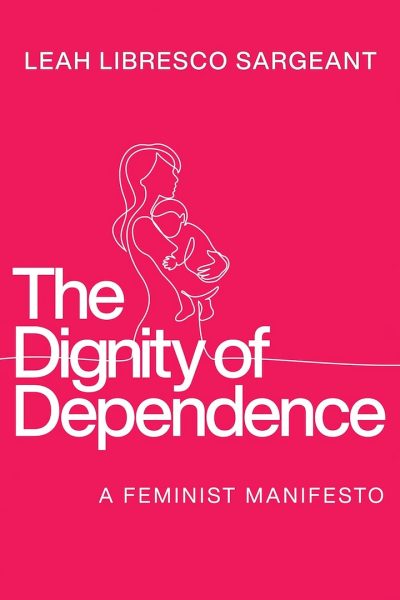
MacIntyre appears in the bibliography of Leah Libresco Sargeant’s new book, The Dignity of Dependence. He is mentioned by name on the last pages. And rightly so: he is a key resource among the many that Sargeant uses to advance what she describes as a new “feminist manifesto.” That word feminist is not entirely positive for this reviewer. As a husband and father, I am old enough to remember, in detail, the 1970s. That includes the subsequent course of secular and dominant feminism, and the devastation it all too often caused.
Sargeant is different. She is part of a current wave of academic women, writers, and leaders—from Erika Bachiochi and Abigail Favale to Terry Polakovic, co-founder of ENDOW, among many others—who offer a feminine critique of culture from a Christian perspective. This opens the door to a broader audience. And the author masters her craft. The Dignity of Dependence is not only exhaustively researched; it is also elegantly written and persuasively argued. It is a pleasure to read. And while it is very much a “feminist manifesto,” it is also the expression of a sensible Christian humanism.
The opening sentences of Sargeant’s first page set the frame for her work: “The world has the wrong shape for women. I move in a world where my body is an unexpected, unforeseen, somewhat uncomfortable guest. It is as if women had arrived late, unexpectedly, to a civilization that developed without them or their needs in mind.” It is a broad and debatable claim. But if it seems like the prelude to a festival of grievances against men, the reader would be mistaken.
For example:
“When the world has the wrong shape for women, they will seek a range of techniques to resolve or dodge their femininity. Our culture is sometimes normed by the masculine, but often the norm that women try to fit into is simply an inhuman norm, one that neither men nor women can comfortably inhabit. Both men and women face pressures to regularize themselves, avoiding strong emotional or physical changes, limiting the intense demands of care, and striving to become interchangeable parts.”
And this:
“Equality for women is not the same as asserting interchangeability with men… Recognizing and honoring the differences between men and women means putting dependence at the heart of our story of what it means to be human. Dependence marks women more obviously and intimately, but it is also impossible to tell the truth about men or treat them justly without taking into account our mutual dependence. No just society can be built on the basis of a false anthropology.”
And finally this:
“It is not good for the woman or the man to be alone, and even more, it is not possible for them to truly be so. To treat each other justly, we must be honest about who we are. Men and women are deeply dependent creatures. We cannot build a just society on a false anthropology. We cannot have a feminism that does not begin by recognizing and rejoicing in the embodied difference between men and women.”
The preceding passages do not do full justice to a text that is intellectually rich and at the same time accessible to any interested reader. Sargeant’s chapters “Helping Women Be Better Men” and “The Incredible Shrinking Woman” detail in practical form the challenges that society, structurally biased against the bodily realities of women, poses to women.
The prospect of one day having artificial wombs, she writes, is presented as a kind of “reproductive justice,” relieving women of the burden of pregnancy—to better guide them toward the workforce. But “we dream of external wombs because it seems more possible,” in a mechanistic and technified culture, “to create biological support for a child in the absence of the mother than to obtain social support to sustain the presence of the mother.”
Sargeant’s chapters “Illegal to Care,” “The Blessings of Burdens,” and “The School of Love” are especially solid. They will resonate with anyone who has a child with special needs (like my wife and I), but also far beyond that community. As the author repeats again and again, there is something wrong, and subtly antihuman, in the way modern society conceives and structures the world. Indeed, it is full of “hostile designs [intended] to displace the needy without worrying too much about where they will go next.”
Before finishing, I will mention the only (modest) reservation I have about this absorbing work. The world may have “the wrong shape for women,” but the author minimizes the considerable soft power that women so often and so easily wield.
I speak from experience. One of my mentors was Andrée Emery, student of Anna Freud, psychotherapist, co-founder of the American edition of the theological journal Communio, friend of Balthasar and Ratzinger, and founder of the secular institute Our Lady of the Way in the United States. She was a woman of supreme goodness, intellect, and grace. And also formidable. In a conversation about the role of the sexes, four decades ago, she informed me—unnegotiably—that America might seem like a patriarchy, but in reality it was the “land of mama’s boys” and a disguised matriarchy.
I was a prudent young man. I did not argue.
About the author:
Francis X. Maier is a senior research fellow in Catholic studies at the Ethics and Public Policy Center. He is the author of True Confessions: Voices of Faith from a Life in the Church.