


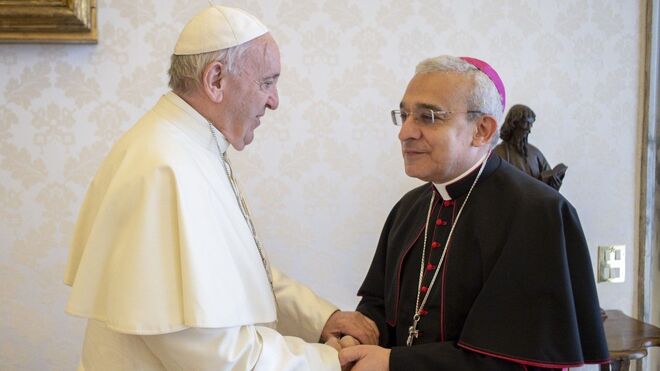
Archbishop Iannone, new prefect of the Dicastery for Bishops
The Italian Carmelite had until now been directing the Dicastery for Legislative Texts.
Pope Leo XIV appointed Archbishop Filippo Iannone this Friday as the new prefect of the Dicastery for Bishops, the most important appointment of his pontificate to date, reported The Pillar.
Iannone, an Italian Carmelite who since 2018 had served as prefect of the Dicastery for Legislative Texts, thus fills the vacancy created in May when Cardinal Robert Francis Prevost, the previous prefect, was elected Pope Leo XIV.
The 67-year-old prelate will also be president of the Pontifical Commission for Latin America, as announced by the Holy See on September 26. He will assume the new role on October 15.
Background
According to The Pillar, Iannone professed his perpetual vows in the Order of Carmel in 1980 and was ordained a priest in 1982. He served as judicial vicar and vicar general of the Archdiocese of Naples before being appointed auxiliary bishop in 2001. In 2009, he became bishop of Sora-Aquino-Montecorvo, in the Italian region of Lazio.
In 2012, he was appointed vice-regent of the Diocese of Rome, becoming third in the diocesan hierarchy after the Pope and the cardinal vicar. Cardinal Agostino Vallini specifically requested him as a collaborator for his capacity as a canonist and his work ethic.
In that role, Iannone had to address canonical issues related to the Istituto Dermopatico dell’Immacolata hospital, embroiled in a high-profile case of corruption and bankruptcy.
In 2017, he was appointed adjunct secretary of the then Pontifical Council for Legislative Texts, and a year later he succeeded Cardinal Francesco Coccopalmerio as president of the body. During his tenure, Iannone opposed radical reform attempts of the Code of Canon Law promoted by Cardinal Gianfranco Ghirlanda, SJ, a close advisor to Pope Francis.
Unlike many other dicastery heads, Iannone was not created a cardinal.
Stance on the German Synodal Way
Iannone has been critical of the so-called German “Synodal Way” (2019-2023). In September 2019, a letter from Cardinal Marc Ouellet to the German bishops was accompanied by a four-page legal report signed by Iannone, in which he warned that many of the issues being debated could not be decided by a particular Church without contravening what the Pope had indicated.
“Synodality in the Church is not synonymous with democracy or majority decisions,” he wrote at the time, recalling that even in a Synod of Bishops in Rome, it is up to the Pontiff to present the results. “The synodal process must develop in a hierarchically structured community”.
Responsibility in abuse cases
Iannone also oversaw the 2023 revision of Vos estis lux mundi, the papal document that regulates procedures for investigating bishops accused of abuses or negligence, and played a key role in drafting the new Book VI of the Code of Canon Law on penal sanctions.
In October 2024, he intervened following a controversial abuse case that pitted the Secretariat of State against the Dicastery for the Doctrine of the Faith regarding Argentine priest Ariel Alberto Príncipi, who was convicted and laicized for child abuses in his country. An order signed by Monsignor Edgar Peña Parra had attempted his restoration to the clerical state through an “extraordinary” procedure.
Iannone explained in an official interview that the Secretariat of State can intervene as a transmitter of decisions from other dicasteries, but emphasized that abuse cases exclusively belong to the Doctrine of the Faith. He also pointed out that a review “in the form of mercy” can only be commissioned by the Pope, suggesting that Francis personally intervened in the case.
Confirmations in the Dicastery
The Holy See also announced on September 26 that Brazilian Archbishop Ilson de Jesus Montanari will continue as secretary of the Dicastery for Bishops and Father Ivan Kovač as undersecretary, both for a new five-year term.
Iannone will officially assume his role on October 15.
Silere Non Possum also provides an editorial analysis of Iannone’s appointment:
Leo XIV begins to reveal himself: the nomination of the Prefect of the Dicastery for Bishops
It has taken only one hundred forty-one days for Leo XIV to imprint a first decisive seal of governance on his pontificate. Not a speech, but a designation. And not just any designation: the Pope has chosen to begin precisely with the Dicastery for Bishops, that body which he himself led from April 12, 2023, until his election to the papal throne. A decision that speaks for itself, more than a thousand words: Prevost has not sought figures external to the Curia, but has preferred to value someone who, during the previous pontificate, had to swallow not a few bitter pills.
The chosen name is that of Archbishop Filippo Iannone, O. Carm., Neapolitan canonist, until today Prefect of the Dicastery for Legislative Texts. A figure of law and balance, Iannone is a man who during the years of Francis learned to take a step back: absorb the blows and keep silent. Not for lack of personal rapport with the reigning Pontiff, but because in that stage speaking of norms and law meant risking appearing as a foreign body. “Nothing has arrived here,” he used to respond to requests for clarifications coming from both Vatican City and the rest of the Catholic Church. Even the texts of the new provisions—which changed constantly, sometimes from one day to the next—did not reach the examination of the Pontifical Council. The Argentine Pope’s aversion to the code, to schemes, and to procedures was well known. Thus, Iannone, although promoted to lead the Pontifical Council for Legislative Texts, was relegated to the margins, confined to a sector that the Pontiff considered secondary, almost an ornament.
Today, however, the cards are being reshuffled. Leo XIV has decided to entrust to a canonist—not someone external, but a Curia man—the responsibility of proposing future bishops to the Pope. It is a forceful gesture that hints at a style of governance.
Few steps, with calm
Filippo Iannone will assume the role on October 15, 2025, taking the reins of the Dicastery for Bishops and the Pontifical Commission for Latin America. In parallel, Leo XIV has confirmed ad aliud quinquennium the current Secretary of the Dicastery, Monsignor Ilson de Jesus Montanari, along with Monsignor Ivan Kovač, who will remain as Undersecretary.
This decision also reveals Prevost’s style. The relationship with Montanari was never easy: during his tenure as prefect, the Secretary often bypassed him, preferring to go directly to Santa Marta to get what he wanted. With Francis, Montanari enjoyed a more fluid relationship than with Prevost. It is no surprise, then, that when Leo XIV emerged from the Sistine Chapel, Montanari was not wearing the red zucchetto of a cardinal elect, and no one was surprised by it.
However, unlike his predecessor, Leo XIV does not let himself be guided by grudges or vendettas. His line is different: act with calm, without abrupt shakes. First, the prefect is changed, then the rest will come.
From law to the election of pastors
To understand the meaning of the designation, one must look at Iannone’s trajectory. Born in Naples in 1957, he entered the Carmelites very young, trained at the Lateran and the Sacred Rota, and is a pure canonist, a man raised among codes and ecclesiastical tribunals. Defender of the bond, judicial vicar, professor of canon law, rotal lawyer: his curriculum is a compendium of the Church’s legal world. But alongside this, he also had pastoral experiences: auxiliary bishop of Naples, then of Sora-Aquino-Pontecorvo, and vice-regent of the Diocese of Rome. He is a man who knows the Church’s difficulties and the problems of governance.
During the pontificates of John Paul II and Benedict XVI, he was recognized and valued. It was John Paul II who made him Italy’s youngest bishop in 2001. It was Benedict XVI who called him to Rome as vice-regent. Then, with Francis, came the presidency of the Pontifical Council for Legislative Texts, which with Praedicate Evangelium became a true dicastery. But in that stage, dominated by the idea that law should yield to pastoral care, Iannone’s role remained opaque, little visible. However, Praedicate Evangelium had outlined a very high profile for the dicastery he directed: authentic interpretation of laws, oversight of illegitimate practices, promotion of canon law, support for episcopal conferences. All crucial tasks that, however, often remained in a drawer due to the style of the reigning Pontiff, who preferred to decide alone.
With Leo XIV, the scenario changes radically. The choice to entrust the direction of the Dicastery for Bishops to a canonist is not casual: the message is unequivocal. No more improvisations, but rules; no more favoritism, but transparent criteria. From the beginning, the new Pontiff made it clear that he will not replicate the “Bergoglio method.” In the selection of bishops, a return is made to an orderly process: the prefect, along with the Dicastery’s apparatus, conducts investigations, gathers opinions, listens to priests from the dioceses of origin and those that might receive the new pastors; finally, presents the Pope with the names of candidates. The Pontiff, in turn, is not a puppeteer who chooses on a whim, but the last to evaluate and decide.
It is the end of an era of improvisations and questionable practices, when a connection to the Santa Marta circle was enough to obtain a diocese. The time of the so-called “beautiful Puglia” or “beautiful Basilicata,” reservoirs from which extractions were made not for merits, but for friendships and favors, perhaps guaranteed by those who arrived with the gift of fresh pasta to the hostel kitchens, is closing.
The Dicastery for Bishops: the beating heart of the Curia
The Dicastery that Iannone is preparing to lead is one of the most delicate. The norms of Praedicate Evangelium describe it precisely: it must deal with the constitution of dioceses, the designation of bishops and their formation, support pastors in governance, organize ad limina visits, oversee the unity and good functioning of particular Churches, and even involve the people of God in the election of candidates. In other words, it is the beating heart of the Curia. Here it is decided who will guide the world’s Catholic communities. And, therefore, the future face of the Church is also defined: whether it will have bishops attentive to doctrine or willing to compromise, whether they will be solicitous fathers to their priests or despotic administrators, whether they will be pastors of prayer or diocesan managers, whether they will have prophetic courage or inclination to mediocrity.
A designation as a program of governance
Today’s designation, therefore, is not a bureaucratic detail, but a programmatic act. Leo XIV has chosen to begin here, and not by chance. Because everything depends on the quality of the bishops: catechesis, liturgy, sacramental life, resource management, closeness to the poor, defense of the faith. A weak episcopate generates disoriented communities. A strong, just, and rooted episcopate, on the other hand, becomes a sign of hope. In an era when the Church seems lost, fragmented, sometimes even bowed to the fashions of the moment, the choice to place a man of law at the helm of designations appears as a precise response: it is not saved by improvisation, but by seriousness, competence, and respect for the rules.