


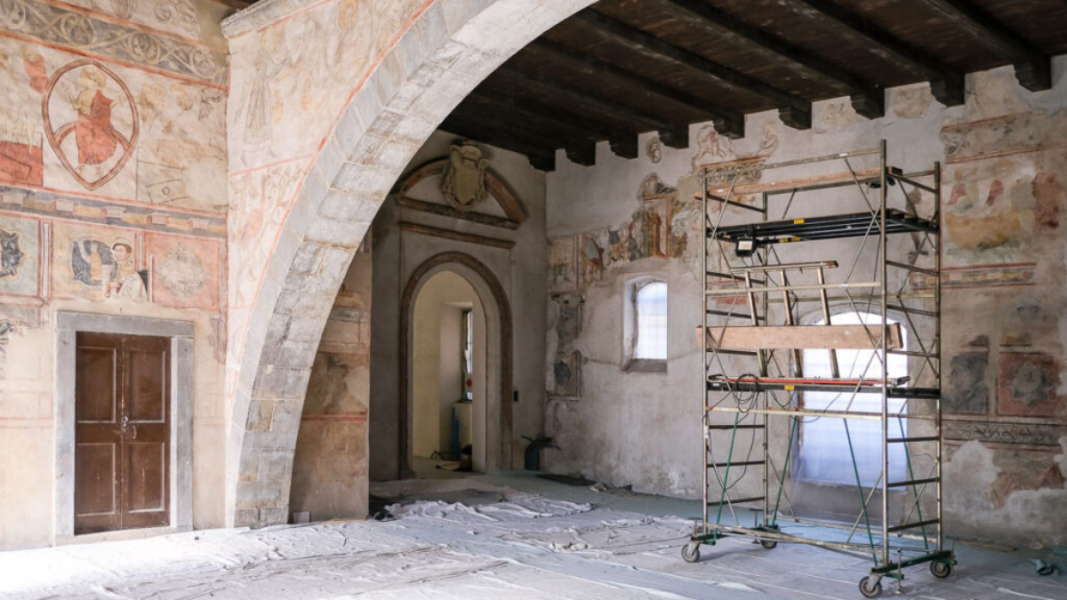
This September 27 and 28 will open its doors in Bergamo (Italy) the renovated Museo Diocesano Adriano Bernareggi, a 900-square-meter space in the historic heart of the city that brings together works from the 14th to the 20th century.
The project, installed in the ancient Episcopal Palace on Colle di San Salvatore, seeks to be more than an artistic collection: “a pilgrimage of the spirit,” in the words of the current bishop of the diocese, Mons. Francesco Beschi, who will cut the inaugural ribbon accompanied by civil and ecclesiastical authorities, as reported by Vatican News.
A museum as a gift and legacy
The museum bears the name of Mons. Adriano Bernareggi, bishop of Bergamo from 1936 to 1953, a key figure in Italian cultural and ecclesial life. “This new headquarters is a gift that comes from afar—explains Mons. Beschi—fruit of Bernareggi’s sensitivity, a protagonist in the drafting of the Código de Camaldoli, a great lover of liturgy and convinced that the proclamation of the Gospel finds in art its most sublime form.”
900 square meters of beauty
The new headquarters offers ten rooms on two floors, with around 60 works of art including paintings, sculptures, and sacred objects. The collection spans seven centuries of history: from medieval sculpture to Lorenzo Lotto and Andrea Previtali, passing through Giovan Battista Moroni, Carlo Ceresa, or Evaristo Baschenis, without forgetting 20th-century art with tributes to Giacomo Manzù and Lello Scorzelli.
The museum will also temporarily exhibit pieces from parishes in the diocese, seeking to be a space for dialogue with the territory and for recomposing the dispersed heritage in the region’s temples.
A message of faith through beauty
Bishop Beschi emphasized that the new museum “is not just a simple collection, but a path of faith, an inner journey.” He recalled the words of St. Paul VI to artists after the Second Vatican Council: “The world needs beauty to avoid falling into despair.”
For Beschi, the museum also seeks to respond to the question recently posed by Pope Francis: what is art for in a wounded world? The answer, he said, is clear: “Art is not a luxury, but a necessity of the spirit. Educating in beauty is educating in hope.”
A museum extended throughout the city
The Bernareggi is not limited to its exhibition rooms. The project includes spaces for conferences, educational activities, and a multimedia room that reconstructs the architectural fabric of the area.
With a single ticket, visitors will also be able to access the Palacio Episcopal with its Aula Picta, the 14th-century baptistery, the remains of the ancient Paleo-Christian cathedral, the Oratorio de San Lupo—dedicated to contemporary art—and, soon, the archaeological area of the Tempietto de Santa Croce, currently under excavation.
The experience spans more than 1,700 years of history, offering pilgrims and visitors a journey where faith and culture meet.