


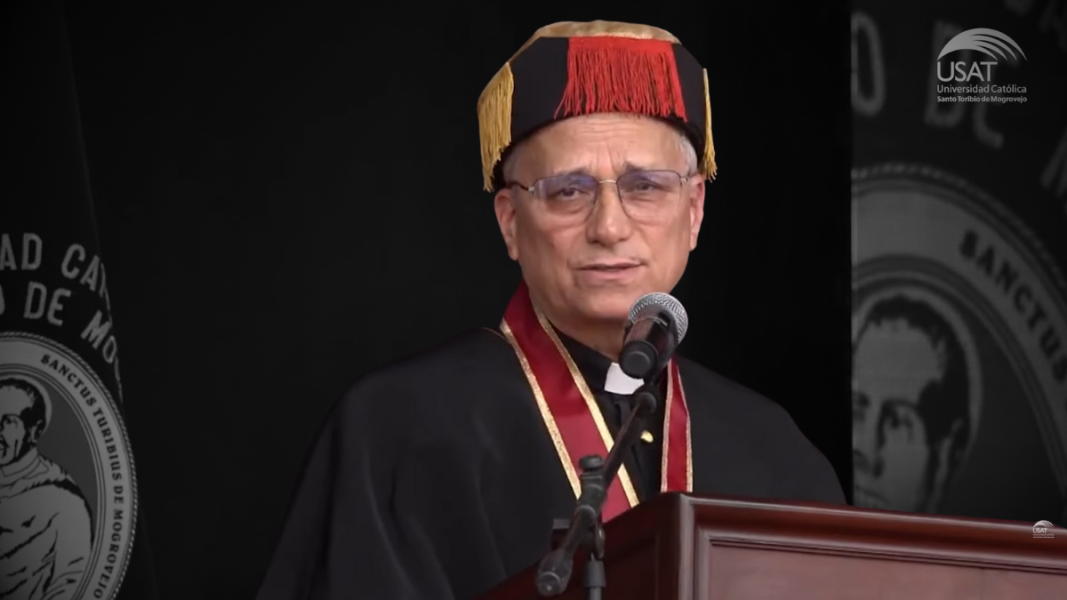
In a speech delivered at the Universidad Católica Santo Toribio de Mogrovejo (USAT) in Chiclayo, Robert Prevost—then bishop of the diocese and now Pope Leo XIV—explicitly defended the Seamless Garment theory formulated in the 1980s by Cardinal Joseph Bernardin in Chicago. Prevost revived that image of the “seamless garment” to remind that the defense of life cannot be fragmented: one must oppose abortion, but also poverty, social exclusion, the death penalty, war, and all forms of violence that wound human dignity.
Bernardin’s intuition—and what Prevost championed in his speech—had a pastoral purpose: to demand coherence, to avoid Catholics being trapped in an ideological reductionism that only defended one cause and forgot the rest. The Seamless Garment called for not being selective, to see life as an indivisible good that must be protected at every stage and in all its dimensions.
However, from its very formulation, not a few warned of the risks of this theory. The first, the temptation to equate evils of very diverse moral gravity. Poverty or war are gravely evil, but not identical to abortion, which is an intrinsic evil: the deliberate elimination of innocent life at its origin. The second, the political use of the concept. In practice, the seamless garment could transform into a rhetorical umbrella to justify alliances with openly pro-abortion politicians, highlighting their actions in other social areas.
What was pointed out as a risk in the 1980s is exactly what we see today in Chicago, the same archdiocese where Bernardin enunciated his theory. Cardinal Blase Cupich, heir to that tradition, publicly awards and praises politicians who actively promote abortion, emphasizing their commitment in areas like immigration or the fight against inequality. The consequence is clear: the Seamless Garment has been used not to reinforce Catholic coherence, but to dilute the centrality of the battle against the culture of death.
The paradox is evident. Bernardin and, at the time, Prevost at the USAT presented the theory as a call to moral integrity. But when abortion is excluded from that equation, the garment tears. The argument empties of meaning and becomes a resource to legitimize as “Catholics committed to life” those who in reality deny the most elemental right: the right to be born.
Defending the theory in its core minimums still has value: it reminds us that the defense of life does not end in a single front and that coherent Catholicism cannot disregard the poor or the discarded. But it is essential to save it from its deviations. Without a clear distinction between the unique gravity of abortion and other social evils, the Seamless Garment becomes an excuse for incoherence.
Today, in light of events, the warning from those who criticized Bernardin is confirmed. What was born as an ideal of integrity has ended up being instrumentalized to reward pro-abortion politicians. And what was meant to be a seamless garment has transformed into a fabric full of patches, unable to offer Catholics a clear moral compass in times of confusion.