


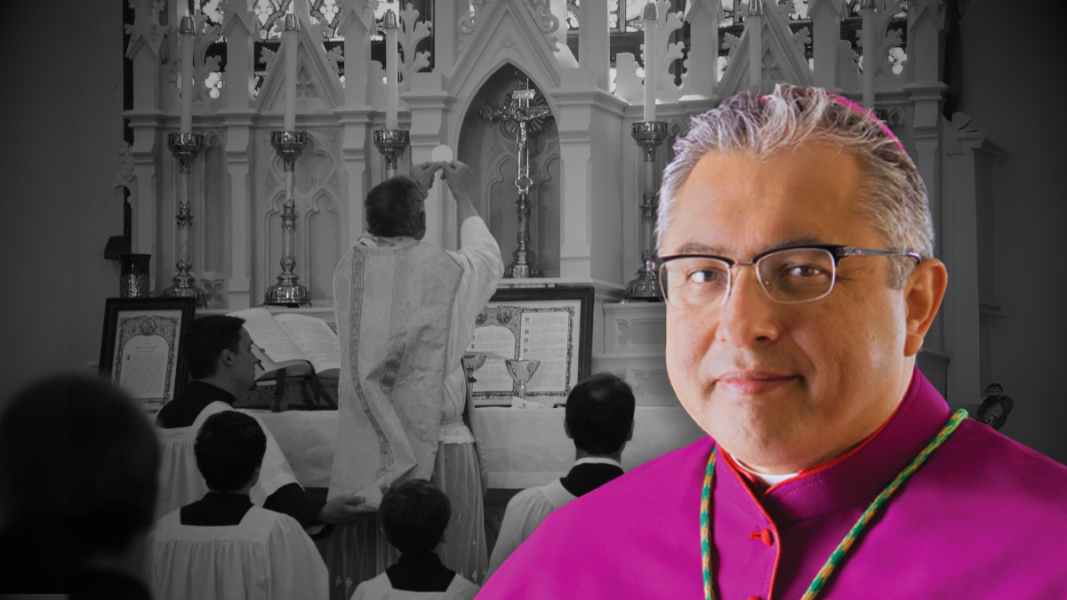
On September 14, the faithful of the Sacred Heart parish in Hollister (California) received a letter from their bishop Daniel E. García, in which he announced that the celebration of the Traditional Mass (Vetus Ordo) will be suppressed starting October 13. The decision is presented as a necessary step to “guarantee liturgical unity,” in strict application of Pope Francis’s motu proprio Traditionis custodes.
Unity as the central argument
In his letter, the bishop states that the pastor’s mission is to lead the Church toward unity, and that this is fully expressed in the liturgy reformed after the Second Vatican Council. Citing St. Paul VI and St. John Paul II, García recalls that the Mass promulgated after the Council is “the sole expression of the lex orandi of the Roman Rite.”
The prelate adds that, although he understands the sensitivity of the faithful attached to the Traditional Mass, “the Church is moving toward greater cohesion in worship.” And he warns that pastors must not encourage liturgical divisions or fuel controversies that, according to him, “can be instrumentalized for ideological purposes.”
A small community facing a vast diocese
The bishop also justifies the measure on pastoral grounds. He points out that, in a diocese with more than 210,000 Catholics, the group attending the ancient Mass is small. Therefore, he considers it necessary for the pastor, Father Stephen Akers, to concentrate his energies on serving the entire community, rather than maintaining a celebration that requires resources for a limited number of faithful.
According to California Catholic Daily, this community gathered faithful from the entire north of the diocese, including large families, and maintained an atmosphere of fraternal hospitality after Sunday Mass, with coffee and fellowship.
The liturgy, which had been celebrated for 17 years in the traditional rite, featured a choir that performed Gregorian chant, polyphony, and liturgical songs a cappella, occasionally accompanied by organ. In addition, the community supported its own seminarian, collaborated with missions in Africa, and backed local charity initiatives.
The parishioners had also invested efforts in restoring the church with its original stained glass windows, Gothic confessionals, and Stations of the Cross, even going so far as to replace the main altar and the communion railings that had been removed decades earlier. The temple offered an atmosphere of recollection, reverence, and prayer.
A final act before his transfer to Austin
The suppression, which will take effect on October 13, will be effective less than a month after the letter’s publication. The decision also comes at a significant moment: García was recently appointed bishop of Austin (Texas), and this will be one of his last acts of governance in the diocese of Monterey and that the decision occurs just before his transfer represents a final imposition to close the issue in Monterey.
Part of a broader trend in the US
The Hollister case is not isolated. Since the promulgation of Traditionis custodes, numerous dioceses in the United States have limited or eliminated the pre-conciliar Mass. In Detroit, for example, several parishes received orders to move the TLM to non-parochial chapels.
These restrictions respond to Pope Francis’s desire to reduce spaces for the traditional Mass, considering that some groups have made it an “ideological use” contrary to the spirit of ecclesial communion.
The Monterey decision thus fits into a broader process that is transforming the liturgical landscape in the United States and that, for the faithful attached to tradition, represents a painful loss of their communal spiritual life.