


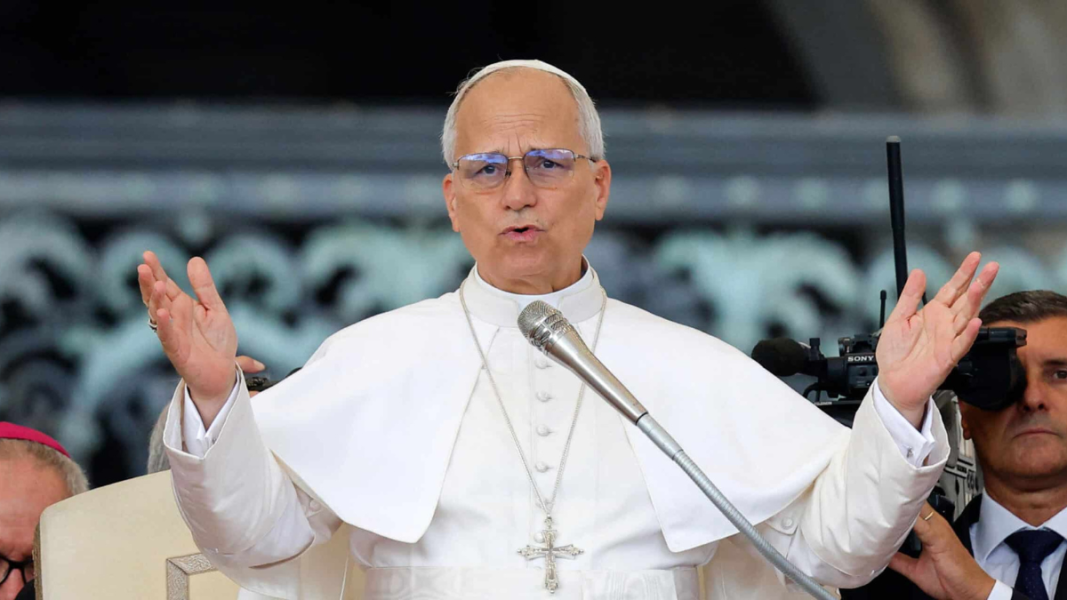
Pope Leo XIV presided over the General Audience this Wednesday in St. Peter’s Square before thousands of pilgrims. Within the framework of the jubilee cycle «Jesus Christ, our hope», he dedicated his catechesis to the mystery of Holy Saturday, taking as a guide the words from the First Letter of Peter: «And in the Spirit he went to preach to the spirits in prison» (1 Pe 3,19). The Pontiff meditated on Christ’s descent into hell as a sign of divine love that reaches even the deepest darkness to announce salvation and open a horizon of hope to all humanity.
We leave below the complete catechesis:
Catechesis Cycle – Jubilee 2025. Jesus Christ, our hope. III. The Easter of Jesus. 8. The Descent.
«And in the Spirit he went to preach to the spirits in prison» (1 P 3,19)
Dear brothers and sisters, good morning!
Today too we pause on the mystery of Holy Saturday. It is the day of the Paschal Mystery in which everything seems motionless and silent, while in reality an invisible action of salvation is taking place: Christ descends into the realm of hell to bring the announcement of the Resurrection to all those who were in darkness and in the shadow of death.
This event, which the liturgy and tradition have handed down to us, represents the deepest and most radical gesture of God’s love for humanity. In fact, it is not enough to say or believe that Jesus died for us: it is necessary to recognize that the fidelity of his love wanted to seek us where we ourselves had lost ourselves, where only the power of a light capable of piercing the domain of darkness can push.
Hell, in the biblical conception, is not so much a place as an existential condition: that condition in which life is weakened and pain, loneliness, guilt, and separation from God and others reign. Christ reaches us also in this abyss, crossing the gates of this kingdom of darkness. He enters, so to speak, into the very house of death, to empty it, to free its inhabitants, taking them by the hand one by one. It is the humility of a God who does not stop before our sin, who is not frightened by the extreme rejection of the human being.
The apostle Peter, in the brief passage from his first Letter that we have heard, tells us that Jesus, vivified in the Holy Spirit, went to bring the announcement of salvation also «to the imprisoned spirits» (1 Pe 3,19). It is one of the most moving images, which is not developed in the canonical Gospels, but in an apocryphal text called the Gospel of Nicodemus. According to this tradition, the Son of God entered the thickest darkness to reach even the last of his brothers and sisters, to bring his light even down there. In this gesture lies all the power and tenderness of the Paschal announcement: death is never the last word.
Dear ones, this descent of Christ is not only about the past, but it touches the life of each one of us. Hell is not only the condition of those who are dead, but also of those who live death because of evil and sin. It is also the daily hell of loneliness, shame, abandonment, weariness of living. Christ enters all these dark realities to witness to us the love of the Father. Not to judge, but to free. Not to blame, but to save. He does it without clamor, on tiptoe, like someone entering a hospital room to offer consolation and help.
The Fathers of the Church, in pages of extraordinary beauty, have described this moment as an encounter: between Christ and Adam. An encounter that is a symbol of all possible encounters between God and man. The Lord descends where man has hidden out of fear, and calls him by name, takes him by the hand, lifts him up, brings him back to the light. He does it with full authority, but also with infinite gentleness, like a father with the son who fears he is no longer loved.
In the Eastern icons of the Resurrection, Christ is depicted as breaking down the doors of hell and, extending his arms, grasping the wrists of Adam and Eve. He does not save himself alone, he does not return to life alone, but he carries all humanity with him. This is the true glory of the Risen One: it is the power of love, it is the solidarity of a God who does not want to save himself without us, but only with us. A God who does not rise again unless he embraces our miseries and lifts us up again for a new life.
Holy Saturday is, therefore, the day when heaven visits the earth most deeply. It is the time when every corner of human history is touched by the light of Easter. And if Christ has been able to descend even there, nothing can be excluded from his redemption. Not even our nights, not even our oldest sins, not even our broken bonds. There is no past so ruined, no history so compromised that cannot be touched by his mercy.
Dear brothers and sisters, to descend, for God, is not a defeat, but the fulfillment of his love. It is not a failure, but the path through which He shows that no place is too far, no heart too closed, no tomb too sealed for his love. This consoles us, this sustains us. And if sometimes it seems to us that we are touching bottom, let us remember: that is the place from which God is capable of beginning a new creation. A creation made of people who have risen again, of forgiven hearts, of dried tears. Holy Saturday is the silent embrace with which Christ presents all creation to the Father to place it back in his design of salvation.