


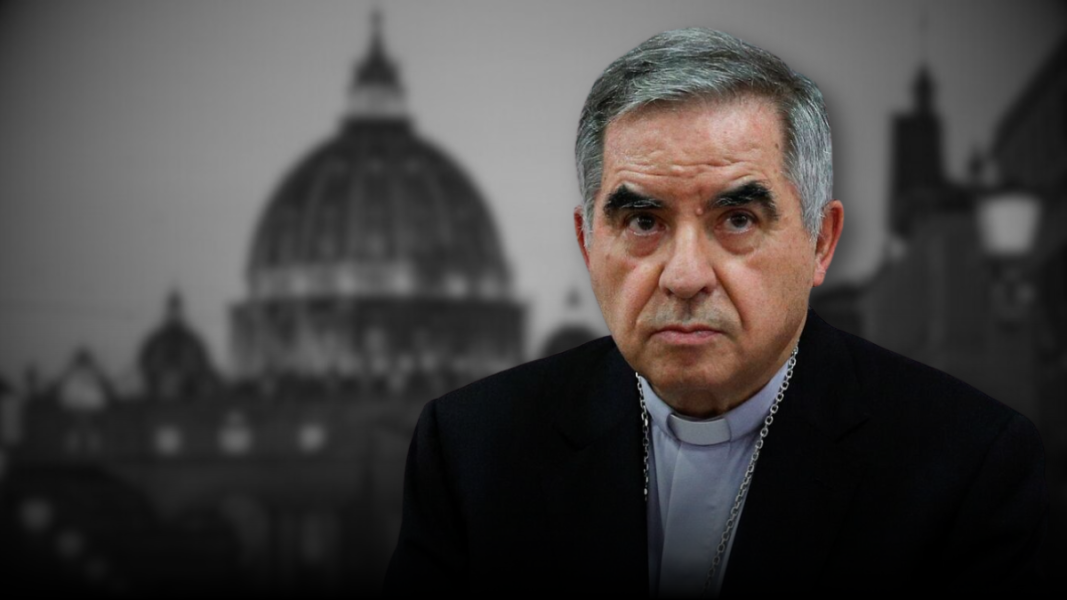
According to Vatican News, the appeal process regarding the management of Holy See funds began on September 22 with an unexpected twist: the defense of Cardinal Giovanni Angelo Becciu and three other defendants filed a recusal request against the Promoter of Justice, Alessandro Diddi, which was deemed “admissible” by the tribunal.
The lawyers argue that Diddi would be implicated in WhatsApp chats with people outside the process who allegedly influenced the testimony of Monsignor Alberto Perlasca, former administrative head of the Secretariat of State and a key piece in the accusations against Becciu. “Finally I can defend myself from a series of insinuations,” the prosecutor replied before stepping away from the hearing. The final decision on his recusal will rest with the Vatican Court of Cassation, composed of Cardinals Farrell, Lojudice, Zuppi, and Gambetti.
The Purchase of the London Palace and the Convictions
The case, remembered as the “trial of the century,” revolves around the failed acquisition of a building on Sloane Avenue in London, which caused losses exceeding 200 million dollars. In December 2023, after 86 hearings, the Vatican tribunal convicted ten defendants, including Becciu, who was sentenced to five and a half years in prison, a financial fine, and perpetual disqualification from public office.
The sentence also reached financiers such as Raffaele Mincione, Enrico Crasso, and Gianluigi Torzi, as well as consultant Cecilia Marogna, accused of spending on luxury items funds intended for a humanitarian mission. It was the first time in history that a cardinal sat in the dock of a Vatican tribunal.
Becciu Between Proclaimed Innocence and Conviction
As National Catholic Register recalls, Cardinal Becciu insists on his innocence and assures that he always acted with papal approval. He defends that the aid sent to a foundation in Sardinia responded to social purposes, and that the funds allocated to Marogna were part of diplomatic operations to free a nun kidnapped in Mali.
The cardinal accuses the prosecutors of having turned him into a scapegoat, denounces procedural irregularities—such as manipulated witnesses and ignored evidence—and claims to be a victim of a media campaign that presented him as guilty from the start.
A Trial Against the Vatican System
But as Specola warns, this is not just a process against Becciu, but against an entire management model in the Holy See. The complaint from the Institute for the Works of Religion (IOR)—the Vatican Bank—against the Secretariat of State itself provoked an unprecedented institutional clash, weakening its financial autonomy and exposing a fracture at the heart of Vatican governance.
The analysis warns that the justice of the Holy See risks being perceived as “opaque” and unable to offer guarantees of impartiality, which could lead international contracts to avoid submitting to Vatican jurisdiction.
Papal Rescripts Under Scrutiny
One of the most controversial points remains Pope Francis’s intervention during the first-instance process, when he issued several Rescripts that granted exceptional powers to the prosecutors. The defenses consider them violations of due process, as they would have allowed secret wiretaps, concealment of documents, and unequal treatment compared to other defendants in parallel processes.
This extraordinary use of papal authority raises, according to critics, a tension between Vatican sovereignty and respect for fundamental rights that the Holy See itself defends in the world.
The Dilemma of Leo XIV
The appeal is unfolding under a new pontificate. Leo XIV inherits a case that is more than a trial: it is a trial by fire for the credibility of the Holy See. The Pope will have to decide whether to continue along the line of his predecessor, marked by exceptional decrees and legal questionings, or to promote a reform that restores transparency and legitimacy to Vatican justice.
What is at stake is not only the fate of Cardinal Becciu or the other defendants. It is the Church’s ability to show that its justice, like its message, can truly be just and credible.