


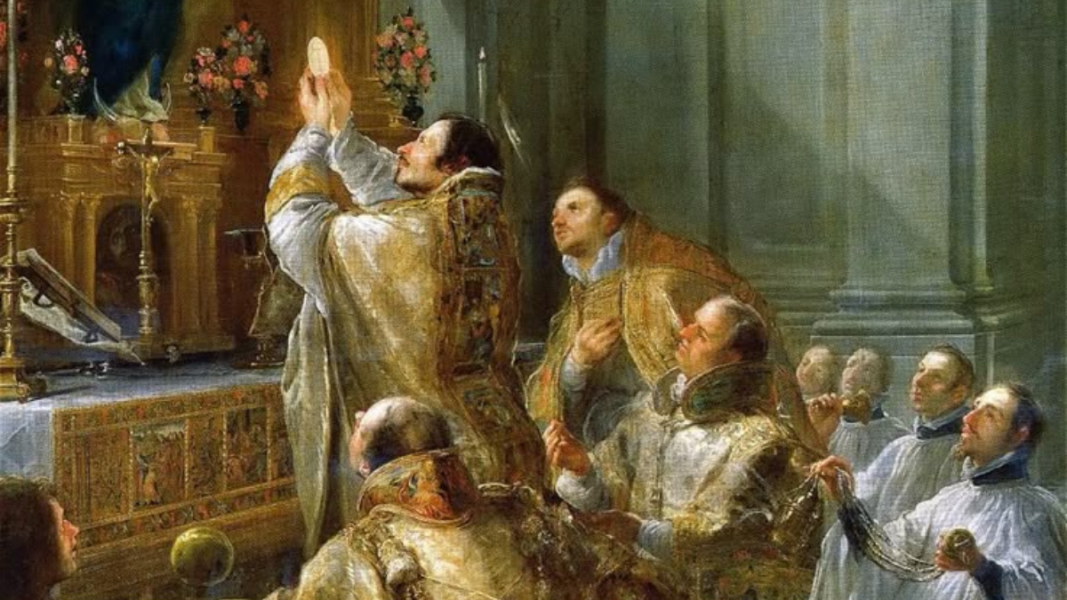
A recent academic work, published in The Catholic Social Science Review by Professor Natalie A. Lindemann of William Paterson University, has put numbers to what traditional Catholics have always defended: the liturgy is not an ornament or mere formalism, but a path that leads—or diverts—from faith in the Real Presence of Jesus Christ in the Eucharist.
The study, conducted among 860 adult American Catholics, confirms that concrete gestures such as receiving Communion on the tongue, hearing the consecration bells, or participating in the Traditional Latin Mass significantly strengthen the faithful’s certainty in the central mystery of the Catholic faith.
Faith in the Eucharist in crisis
The diagnosis is concerning: only 31% of the surveyed Catholics are certain that the Body and Blood of Christ are truly present in the Eucharist. 23.6% affirm with the same certainty that it is merely a symbol. The rest are divided between doubt, probability, and indifference.
This anemia of faith does not arise in a vacuum. For decades, studies have warned that Eucharistic faith has declined in parallel with the loss of liturgical practices that highlighted the sacredness of the altar, gestures, and Communion. Lindemann’s research confirms, with data, that the weakening of the liturgy has gone hand in hand with the weakening of faith.
The language of gestures: receiving Communion kneeling and on the tongue
The numbers speak for themselves. Those who have received Communion on the tongue believe more firmly in the Real Presence (3.27 out of 5) than those who have never done so (2.79). The difference is even greater between those who always receive on the tongue (3.69) versus those who always do so in the hand (3.0).
But beyond the averages, what is decisive is the meaning. Those who affirm that everyone should receive Communion on the tongue reach an average Eucharistic faith score of 4.32, compared to 2.62 for those who defend Communion in the hand. It is not a mere hygienic detail or «pastoral convenience»: it is body language that educates the faith or weakens it.
The Traditional Latin Mass: a refuge of certainty
The study confirms what many priests and faithful experience every day: where the Traditional Latin Mass is celebrated, faith in the Real Presence remains firmer. Catholics who belong to parishes with TLM reach an average of 3.63, compared to 3.04 for those who have never had access to it.
And it is not just a matter of geographical presence. Those who have personally attended the ancient liturgy rise to 3.83, while those who have had no contact at all stay at 3.07. Even subjective perception matters: those who value the Latin Mass positively reach 3.74, while those who despise it plummet to 2.44.
Bells, reverence, and politics
Another striking datum: the consecration bells, eliminated in many churches after the Council, remain a powerful reminder that something extraordinary is happening there. The faithful who have always heard them show a clearly stronger faith (3.43) than those who have never heard them (2.53).
This is added to other factors: greater Mass attendance and a conservative political outlook correlate with greater certainty in Eucharistic faith. In contrast, sex, age, or the location of the tabernacle show no relevant relationship.
The teaching of the study: return to the sacred
Lindemann’s work is not an academic anecdote. It is an urgent reminder for bishops, priests, and laity: the liturgy is not a neutral terrain where anything goes. It is a language that shapes faith. And when that language is stripped of the sacred, faith withers.
The author’s recommendations align with what many faithful have been asking for decades: recover Communion on the tongue and kneeling, reinstate the consecration bells, make space for the Traditional Latin Mass, and reserve the distribution of the Eucharist to the priest. They are concrete gestures, but loaded with content: they express reverence, teach the faithful, and transmit what the dogma proclaims.
It is not a matter of nostalgia or aesthetics. It is a matter of returning to the essential: recognizing and honoring the living Christ in the Most Blessed Sacrament.