


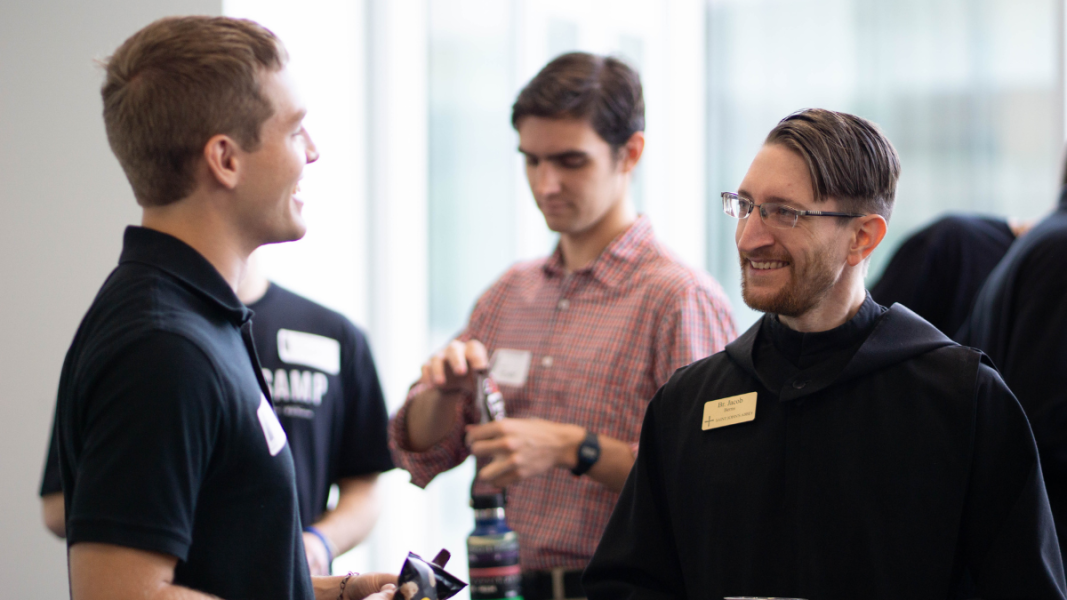
On September 13th, 36 students from the University of St. Thomas (UST) in St. Paul, Minnesota, participated in the first edition of “Monasticamp”, an immersion day in monastic life, as reported by National Catholic Register.
Among them, the seminarian Sean Czaplewski, 18 years old, highlighted the opportunity to experience a full day marked by the Liturgy of the Hours, the Mass, workshops on spirituality and monastic culture, as well as sessions of Gregorian chant and community reflection.
The event was organized by Kathryn Wehr, a professor in the UST Department of Catholic Studies and a Cistercian oblate, with the aim of bringing young people closer to the Benedictine charism and showing how the Rule of St. Benedict remains a path of discernment and Christian life.
A day of prayer, chant, and teaching
The day began with the prayer of one of the “hours” in the university chapel, following the choral style of monasteries. Afterward, the students received training on Gregorian chant from Elena Zolnick, director of sacred music at the St. Paul Seminary.
The Mass was celebrated by the Benedictine Father Lew Grobe, who in his homily recalled St. John Chrysostom and exhorted to allow oneself to be transformed by God’s mercy: “May our life, not just our words, proclaim faith and trust in the Lord.”
Throughout the day, monks from the St. John’s Abbey in Collegeville and Benedictine sisters from the St. Joseph Monastery offered workshops on lectio divina, community spirituality, and the meaning of monastic vows.
The relevance of the Rule of St. Benedict
One of the central moments was the talk by Father John Klassen, emeritus abbot of St. John’s Abbey, who explained the relevance of the Benedictine Rule as a model of life centered on Christ, which balances prayer, work, and community life.
“After 1,500 years, it remains a proven and enduring way to live the Christian life,” he affirmed. “Benedict is convinced that by praying, working, and living in community, one is gradually transformed, becoming more conformed to the Gospel.”
Vocations and the search for authenticity
Although the camp was not presented as a vocational retreat, many young people discovered in it a space to rethink their life of faith. Wehr noted that the students “are hungry for authenticity” and that experiences like this can spark vocations or, at least, the desire to draw closer to God.
The student Stephanie Rash, 20 years old, acknowledged that she had never prayed the Liturgy of the Hours or practiced Gregorian chant, but valued the experience: “Although I don’t feel a call to religious life, it’s good to know how consecrated people live and learn new forms of prayer.”
An experience that leaves a mark
The day concluded with the Gregorian chant of the hours and an atmosphere of fraternity that united seminarians, university students, monks, and nuns.
In the words of seminarian Czaplewski, “immersing oneself in monastic life for a day helps to open up more to what it really means to live for God.” For many, Monasticamp was a seed of contemplation that invites integrating into university life the rhythm of prayer, silence, and community proper to monasteries.