


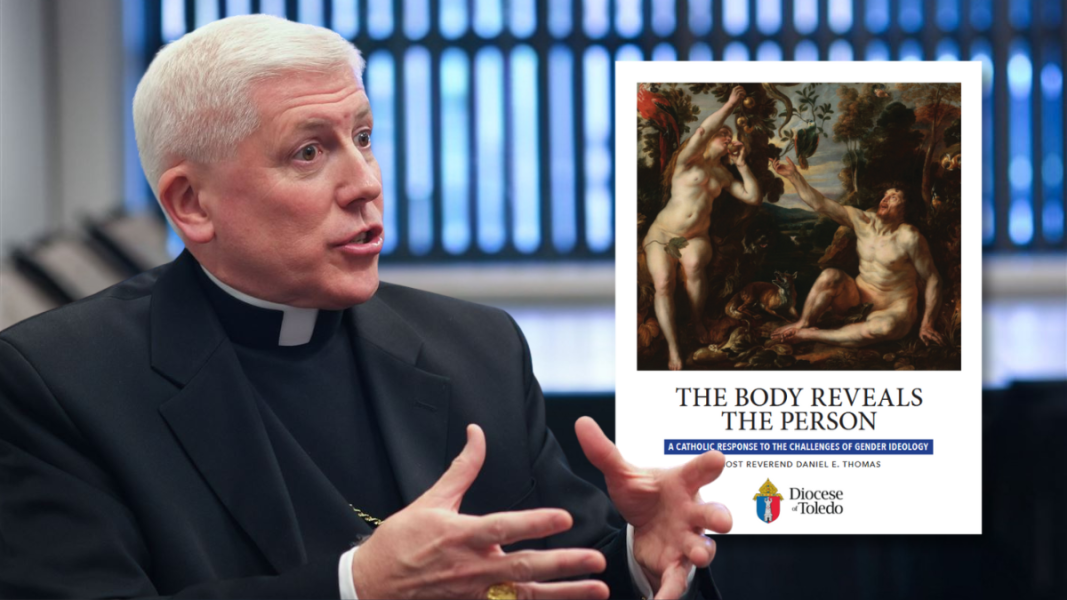
The Bishop of Toledo, Ohio (USA), Monsignor Daniel Thomas, published in August the pastoral letter The Body Reveals the Person: A Catholic Response to the Challenges of Gender Ideology (“The body reveals the person: a Catholic response to the challenges of gender ideology”), a 7,700-word text that has become the longest and most comprehensive statement by a U.S. bishop on gender ideology.
In the document, officially disseminated by the Diocese of Toledo, Monsignor Thomas warns that attempting to change one’s gender amounts to a form of “medically assisted self-mutilation.” However, he emphasizes that those suffering from their sexual identity should not feel rejected, but welcomed in the truth: “Christ loves them, the Church loves them, and I love them,” the bishop writes.
Bishop Thomas’s vision
As reported by the National Catholic Register (NCR), the prelate recalls that the human body has an “inherent meaning” because it is “the tangible revelation of the whole person.” Drawing on the theology of the body of St. John Paul II, he underscores that body and soul form a single nature, and therefore the body “reveals the person as man or woman.”
Monsignor Thomas rejects positions that uphold a dualism between mind and body, as that view opens the door not only to transgenderism, but also to the justification of abortion or euthanasia, and even contradicts the Christian faith in the resurrection.
Reactions and support from experts
The publication has generated numerous reactions in cultural and ecclesial circles. According to Catholic News Agency (CNA), Mary Rice Hasson, director of the Person and Identity Project at the Ethics and Public Policy Center, praised the document for its clarity: “Monsignor Thomas shows that the rejection of the body is actually a rejection of oneself, a self-destruction of something that is good and true.”
Other experts consulted by the NCR also highlighted the value of the text. The priest and bioethicist Tadeusz Pacholczyk described it as “an important teaching document,” noting that it convincingly presents the truth that human identity is not based on feelings or desires, but on the objective reality of the body.
Testimonies showing pastoral impact
The bishop himself told the NCR that, before publishing the letter, a father broke down in tears upon learning that his son was considering a gender transition. After the text’s dissemination, a mother confessed that she sent it to her son and that it opened a deep dialogue: “He was touched by some of the arguments,” she explained.
With biblical examples, such as Jesus’s encounter with the Samaritan woman at Jacob’s well, Monsignor Thomas insists that the Church must proclaim the truth without renouncing mercy: “Jesus reveals to the person their reality, and at the same time loves them with great compassion.”
A call to the rest of the Church
Mary Rice Hasson urged, in statements to CNA, other bishops to follow this example: “In many dioceses, nothing has yet been said on this matter. People want to hear the voice of their shepherds.”
With this document, Toledo sets a point of reference in the U.S. ecclesial debate on gender identity, at a time when cultural pressure seeks to alter language and pastoral practice. Monsignor Thomas reminds us that fidelity to the truth cannot be dissociated from charity, and that true accompaniment requires coherence between doctrine and Christian life.