


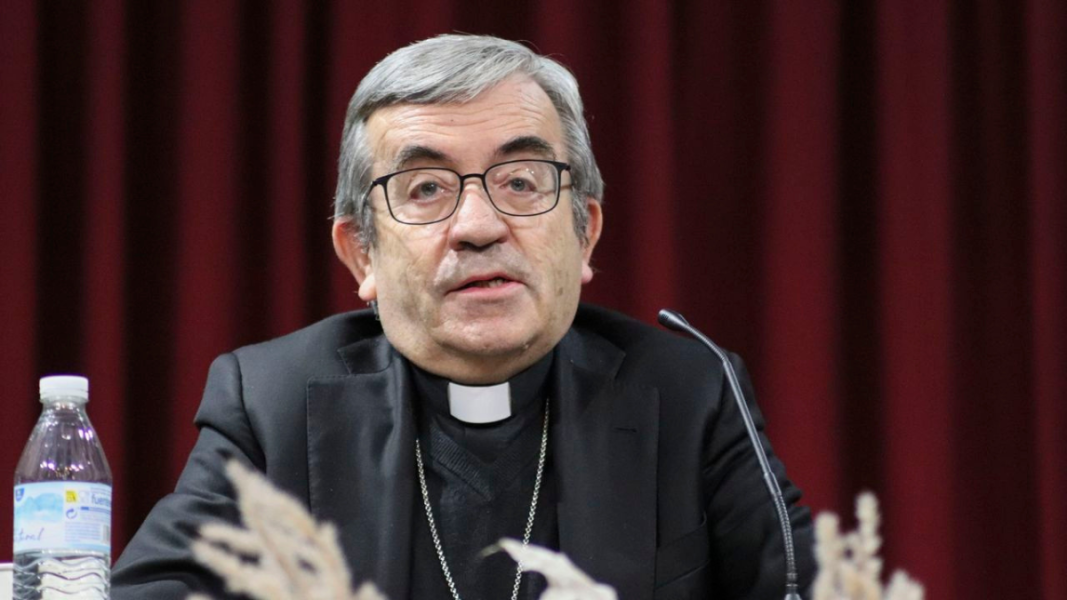
The president of the Spanish Episcopal Conference (CEE), Mons. Luis Argüello, participated yesterday, September 17, in a colloquium at the headquarters of the Pablo VI Foundation in Madrid, together with the president of the Generalitat of Catalonia, Salvador Illa.
The bishop defended the need for Spanish society to recover the capacity for dialogue and encounter, emphasizing the responsibility of political leaders and media outlets, but also that of the citizens themselves.
The Church as a Space of Reference
In his intervention, Mons. Argüello stated that the challenge does not solely correspond to political institutions, but is a common task:
“We have the challenge as a society, when it comes to making permanent exercises of this desire for dialogue, encounter, and building bridges”.
The president of the CEE recognized and lamented that the Catholic Church in Spain is not being sufficiently referential in this task, pointing out that it itself also suffers from “the contagion of polarization”.
Criticism of Internal Polarization
Argüello was clear in recognizing that in the Church there is no “happy Arcadia”, but tensions and divisions are also experienced:
“Just as we experience the contagion of polarization, we must make an effort, live it as a mission, to spread it”.
In this sense, he asked Catholics to commit to a culture of encounter that transcends political or ideological labels.
Photos with Illa and Abascal: the Controversy of Equidistance
Mons. Argüello alluded to the media instrumentalization of his public gestures, recalling that he does not fear appearing in photos with both the socialist leader Salvador Illa and the president of Vox, Santiago Abascal:
“I am not ashamed of either of the two photos. Although for the media, one serves to call me the red of the 70s and the other the fascist of the 21st century”.
The prelate thus defended his role as a pastor who should not be ashamed to dialogue with representatives of different political sensitivities.
Dialogue Yes, but Without Confusion
Mons. Argüello’s call for dialogue and rejection of polarization is a timely message. However, the risk lies in equidistance turning into ambiguity. The Church is not called to position itself in a middle ground between opposing ideologies, but to illuminate public debates with the truth of the Gospel.
In times when Spain faces a moral and political crisis, the voice of the Church must be clear and prophetic: building bridges cannot mean diluting the truth or lowering principles in the name of consensus. The true challenge is for the Church to be a reference, not because of neutrality, but because of fidelity to Christ.