


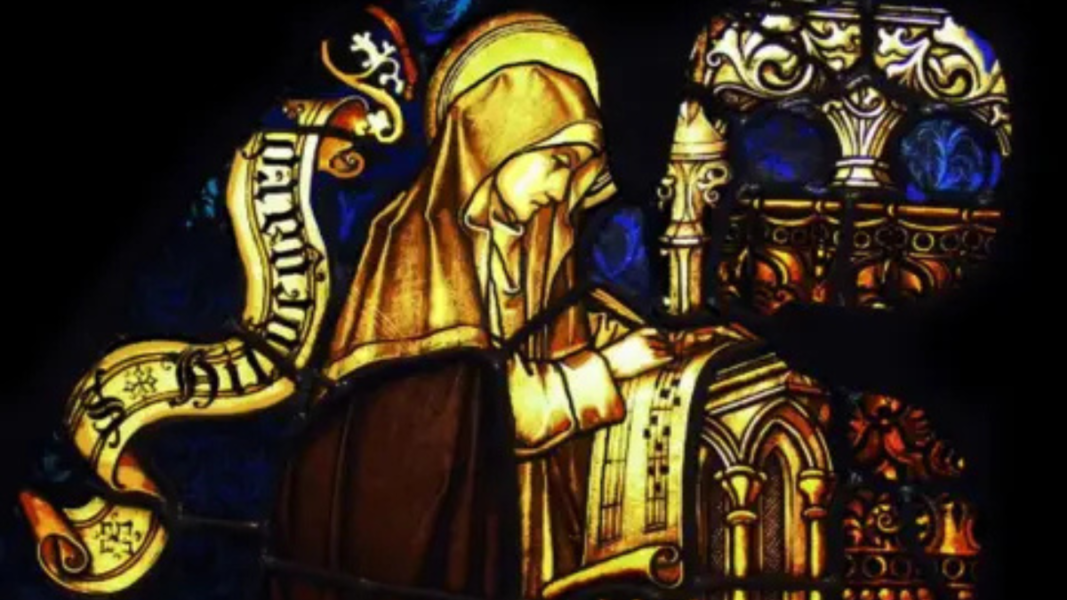
Saint Hildegard of Bingen was born in 1098 in Bermersheim, in the Rhine Valley (present-day Rhineland-Palatinate, Germany), into a noble family. She was the tenth daughter of Hildebert of Bermersheim and Matilda of Merxheim-Nahet, and according to the medieval mindset of the time, she was offered to God as a “tithe,” destined from birth to religious life.
At the age of fourteen, she entered the cloister at the monastery of Disibodenberg with Countess Judith of Spanheim, who had instructed her in praying the psalter, reading Latin, the Holy Scriptures, and Gregorian chant. In 1114, she took vows under the Benedictine rule and, after Judith’s death in 1136, was elected abbess of the community.
Mystical experiences and visions
From childhood, Hildegard experienced visions accompanied by light, colors, and music, which she interpreted as divine messages. In 1141, at the age of 42, she received a supernatural command to write down her experiences. Thus was born her first major work, the Scivias (Know the Ways), with the help of the monk Volmar and the nun Ricardis of Stade.
Uncertain about the nature of these revelations, she wrote to St. Bernard of Clairvaux seeking advice. The abbot encouraged her to humbly accept the gift received and even interceded with Pope Eugene III, who publicly approved part of her writings during the Synod of Trier (1147-1148). From then on, Hildegard was recognized as the “Teutonic prophetess” and began an intense correspondence with popes, kings, and nobles of her time, including Frederick Barbarossa and Eleanor of Aquitaine.
Writer, physician, and composer
In addition to the Scivias, Hildegard wrote treatises on medicine and natural sciences (Physica and Causae et Curae), where she recorded knowledge of herbalism and therapies of her era. She also composed the Symphonia armoniae caelestium revelationum, a collection of hymns and liturgical chants, and other theological works such as the Liber vitae meritorum and the Liber divinorum operum.
In 1150, she founded the monastery of Rupertsberg, and in 1165 another in Eibingen, which she visited weekly. Her fame attracted the attention of Emperor Barbarossa, who in 1163 granted perpetual imperial protection to the convent.
Preacher and reformer of the clergy
She surprised her contemporaries by leaving the cloister to preach in various cities in Germany, denouncing the corruption of the clergy, calling for conversion, and combating Cathar heresy. She also intervened in the disputes of the Western Schism, prophetically admonishing the emperor and the antipopes.
Her firmness led her to even challenge the prelates of Mainz in 1178, when she refused to exhume the body of a noble buried in sacred ground despite having been excommunicated. She defended her position in a letter on the theological meaning of music in the liturgy and succeeded in lifting the interdict imposed on her community.
Death, cult, and canonization
Saint Hildegard died on September 17, 1179, at the age of 81. Chronicles of the time narrate that at the moment of her death, a luminous cross formed by two arches of colors appeared in the sky.
Although her formal canonization was delayed, her cult spread widely. She was venerated as a saint from the 13th century, included in the Roman Martyrology and local litanies. In 2012, Pope Benedict XVI proclaimed her a Doctor of the Church and extended her cult to the universal Church.
Today, she is remembered as a mystic, prophetess, writer, physician, composer, and one of the great women of medieval Christendom, whose prophetic voice continues to challenge the Church and the world. Her liturgical feast is celebrated on September 17.
Source: Aciprensa