


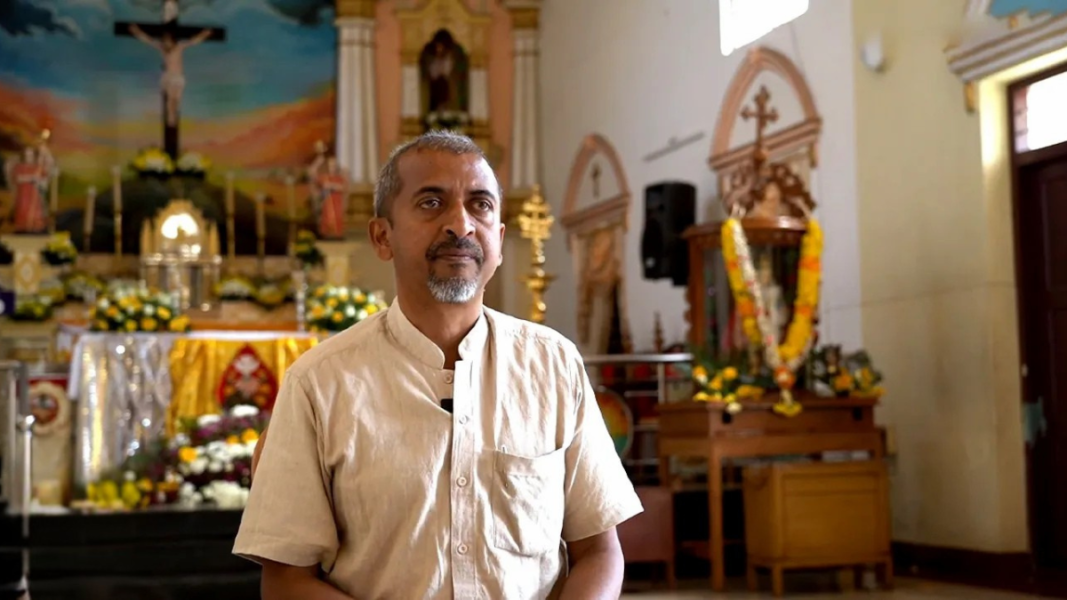
A new episode in the prolonged liturgical dispute of the Syro-Malabar Church erupted this month in India. According to The Pillar, Father Augustine Vattoly, known for his social activism, submitted his resignation as vicar of St. Augustine’s Parish in Kadamakkudy (Kerala) after being asked to celebrate the “Unified Mass,” the common liturgy approved by the Syro-Malabar Church Synod. Local media confirmed the resignation and its motivation in a public letter from the priest.
In a letter addressed to Archbishop Joseph Pamplany—vicar of the major archbishop for Ernakulam-Angamaly since January 11, 2025—and dated September 14, Vattoly explained that he had never adopted the new liturgical form, in which the priest alternates his orientation between the people and the altar. Like the majority of the clergy in the Archdiocese of Ernakulam-Angamaly, he continues to celebrate facing the faithful throughout the entire Eucharist.
The 54-year-old priest noted that a parishioner had expressly requested the celebration according to the new format, but he was not willing to accept it. In his letter, he stated that the liturgical conflict “contradicts the teachings of Christ” and affirmed that he will only withdraw his resignation if the celebration facing the people is officially recognized as a legitimate variant in the archdiocese.
What is the Unified Mass?
The “Unified Mass” establishes that the priest celebrate facing the people during the Liturgy of the Word, turn toward the altar during the Eucharistic Liturgy, and, after Communion, resume the orientation toward the assembly. This formula was approved in August by the Synod of Bishops as part of a compromise to end years of protests in Ernakulam–Angamaly, where the majority of the clergy and faithful continue to celebrate the Eucharist facing the people from beginning to end, a practice that became widespread after the Second Vatican Council. The current agreement requires parishes in the archdiocese to celebrate at least one Unified Mass on Sundays and holy days of obligation, while maintaining the rest of the celebrations according to the usual scheme.
A Historical Background of Divisions
The Syro-Malabar Church, with more than 4.6 million faithful, traces its roots to the preaching of Saint Thomas the Apostle and followed the East Syriac rite for centuries under the jurisdiction of the Church of Persia. The Synod of Diamper (1599), imposed by the Portuguese, forced the latinization of the rite and Roman jurisdiction, causing a fracture that marked its history.
Although the Catholic branch recovered its autonomy in 1923 and was elevated to Major Archiepiscopal Church in 1992, tensions around the liturgy have been constant, particularly regarding the manner of celebrating the Eucharist.
Rome’s Effort to Consolidate Unity
On August 28, Pope Leo XIV arranged a reorganization of the Syro-Malabar Church to strengthen internal communion. Among the measures, the appointment of new bishops and the creation of four ecclesiastical provinces stand out. According to the Holy See, this is a bet to overcome divisions that in recent years threatened to lead to a schism.
Father Vattoly’s resignation, however, shows that the implementation of the Unified Mass remains a critical point in the daily life of Catholics in Kerala, where the tension between tradition and obedience to the Synod’s decisions has not yet been fully resolved.