


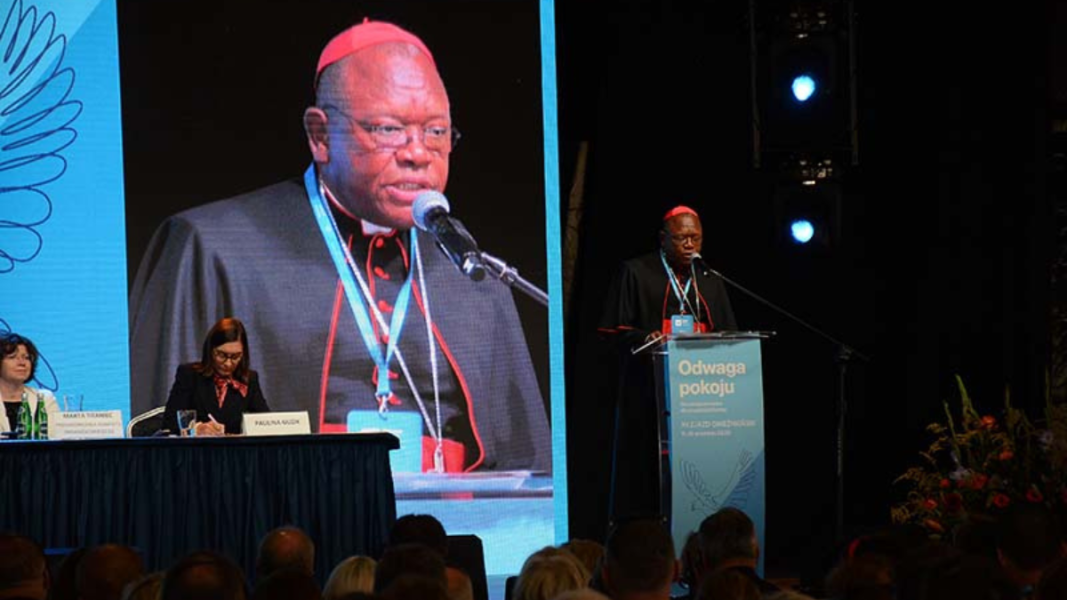
In the context of the Council of Gniezno, held from September 11 to 14 in Poland under the motto “The courage of peace. Christians together for the future of Europe”, the Congolese cardinal Fridolin Ambongo Besungu reiterated his criticisms of the document Fiducia supplicans and defended the role of the Pope as guarantor of Catholic unity and as the prophetic voice of the Church.
In statements to OSV News, the Archbishop of Kinshasa and president of the Symposium of Episcopal Conferences of Africa and Madagascar (SECAM) assured: “The Pope is not there to create doubts, but to confirm the faith and be the prophetic voice of the Church in a world without values”.
Inspiration from St. John Paul II
The cardinal highlighted the personal importance that his first visit to Poland, the homeland of St. John Paul II, had for him: “Intellectually, I was formed by the pontificate of John Paul II with his social encyclicals. His example and support for the Solidarity movement deeply marked our generation”, he explained to OSV News.
Congo: wealth that becomes a curse
Regarding the situation in his country, Ambongo lamented that the natural wealth of the Congo, instead of being a source of development, has become a cause of wars and looting: “The misfortune of the Congo is its wealth. Everyone wants to appropriate our minerals and forests, while our people suffer”, the cardinal denounced, recalling that the Catholic Church has promoted a Social Pact for Peace and Coexistence to foster dialogue in the Great Lakes region.
The cardinal assured that the Vatican, including Pope Leo XIV, is aware of this initiative and supports it: “The Pope encourages us to move forward”, he affirmed.
Unity of the Church and rejection of Fiducia supplicans
Questioned by OSV News about the current challenges of the pontificate, Ambongo responded: “The first responsibility of the Pope is to maintain the unity of Catholics. His mission is to confirm in the faith, not to create doubts”.
Regarding Fiducia supplicans, the cardinal was blunt: “I believe Fiducia is a bad chapter in the history of Pope Francis, because it was published between the two sessions of the Synod on Synodality without having been discussed”. As he explained, the document provoked indignation among the faithful, priests, religious, and bishops across the entire African continent.
As president of SECAM, Ambongo coordinated a common response: he asked each episcopal conference to analyze the text and send their observations. The result was a seven-page document that he himself took to Rome: “The day I arrived, Pope Francis received me and understood our approach. He authorized us to publish the text that clearly stated: ‘No to the blessing of homosexual couples in African churches’”.
The prophetic voice of Africa in the face of secularism
Ambongo defended the essential role of the African Church in global Catholicism: “The Church in Africa has no complexes. It does not tremble before the powerful. It is a Church that raises its head and speaks with a prophetic voice”, he declared to OSV News.
He compared this attitude to that of the West, where, according to him, “there is a tendency to sideline the voice of the Church, as if it were outdated, while seeking to give a modern image”. In response to this, he claimed the strength of a Church that in Africa remains a sign of hope: “Our role is to remind that what matters is not military or economic power, but the dignity of every human being”.