


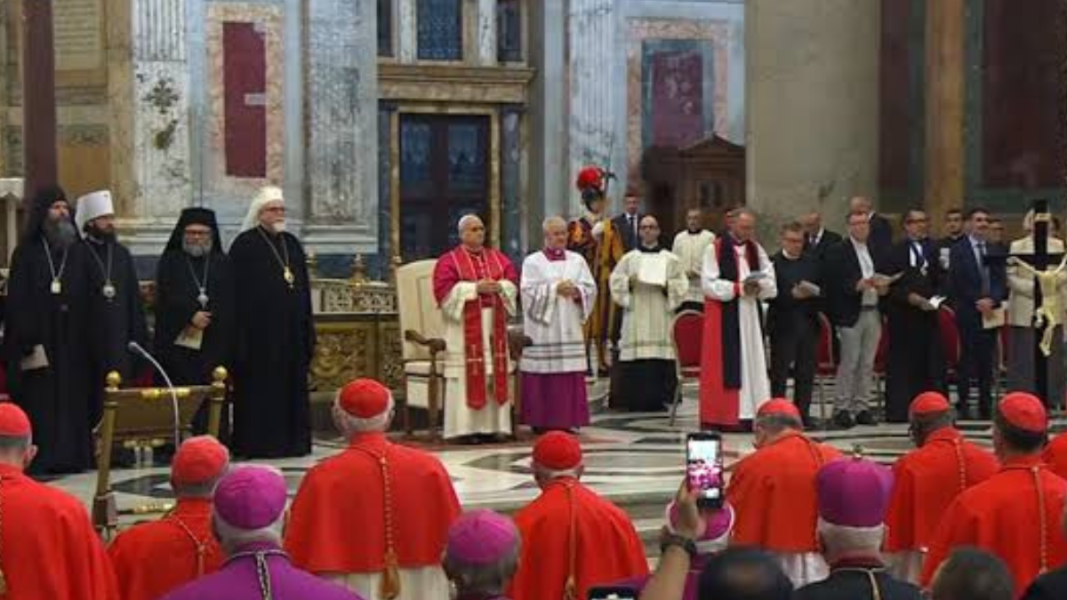
This Sunday, September 14, in the Basilica of Saint Paul Outside the Walls, Pope Leo XIV presided over the Commemoration of the new martyrs and witnesses of the faith of the 21st century. In his homily, he emphasized that Christians persecuted in various parts of the world are symbols of an “unarmed hope,” a hope that does not rely on force or violence, but on fidelity to the Gospel. As the Pontiff highlighted, the martyrs have not renounced their faith despite threats, oppression, or death, and with their example they have shown that Christian witness is capable of standing firm even in the most adverse circumstances.
Concrete testimonies of faith unto martyrdom
During the celebration, the Pope recalled some concrete faces that embody that hope. He mentioned the American nun Dorothy Stang, assassinated in Brazil in 2005, who, when asked to take up a weapon, raised her Bible saying: “This is my only weapon.” He also remembered the Chaldean priest Ragheed Ganni, killed in Mosul in 2007 after celebrating Mass, and the Anglican brother Francisco Tofi, murdered in the Solomon Islands in 2003 for his work in disarmament and reconciliation processes. With these examples, the Pontiff wanted to show that, although the world sees defeat in them, their voice and the love they gave remain alive as a seed of faith.
The face of God on the cross
Leo XIV insisted that the martyrs direct their gaze to the Crucifix, because in Christ’s cross the true face of God is revealed: not imposing power, but compassion that solidarizes with the sufferings of humanity. He recalled that Jesus took upon himself the hatred and violence of the world, and thus his disciples today share the same fate. Women, laity, religious, and priests, said the Pope, have shed their blood for fidelity to the Gospel, for justice, for religious freedom, and for solidarity with the poorest in contexts where hostility offers no respite.
The living memory of the new martyrs
The Holy Father also emphasized the importance of keeping alive the memory of these testimonies. He spoke of the work of the Commission for the New Martyrs, created in the Dicastery for the Causes of the Saints in collaboration with the Dicastery for Promoting Christian Unity, which is responsible for collecting the stories of those who have been killed out of hatred for the faith. Among them, he remembered the Pakistani child Abish Masih, only ten years old, murdered in Lahore in 2015, who wrote in his notebook a desire to “make the world a better place.” He also evoked the figure of the Italian missionary Leonella Sgorbati, killed in Mogadishu in 2006 and beatified in 2018, as well as the Christians attacked in Burkina Faso in 2019 and the twenty-one Orthodox Copts murdered by the Islamic State in Libya in 2015. All of them, he affirmed, are lamps lit at the foot of the cross, lights that violence cannot extinguish.
The victory of good over evil
The celebration concluded with the lighting of lamps as a sign of the faith that persists despite persecution. For Leo XIV, today’s martyrs are a prophetic witness that violence and hatred do not have the last word. Their sacrifice is a call to Christians around the world to live coherently, to keep the memory active of those who have given their lives, and to commit to human dignity. In his words, the “unarmed hope” of the martyrs anticipates the definitive victory of good over evil.