


By: Víctor Lenore
The first macro-concert in history in St. Peter’s Square turned out to be predictable and more focused on civility than on God
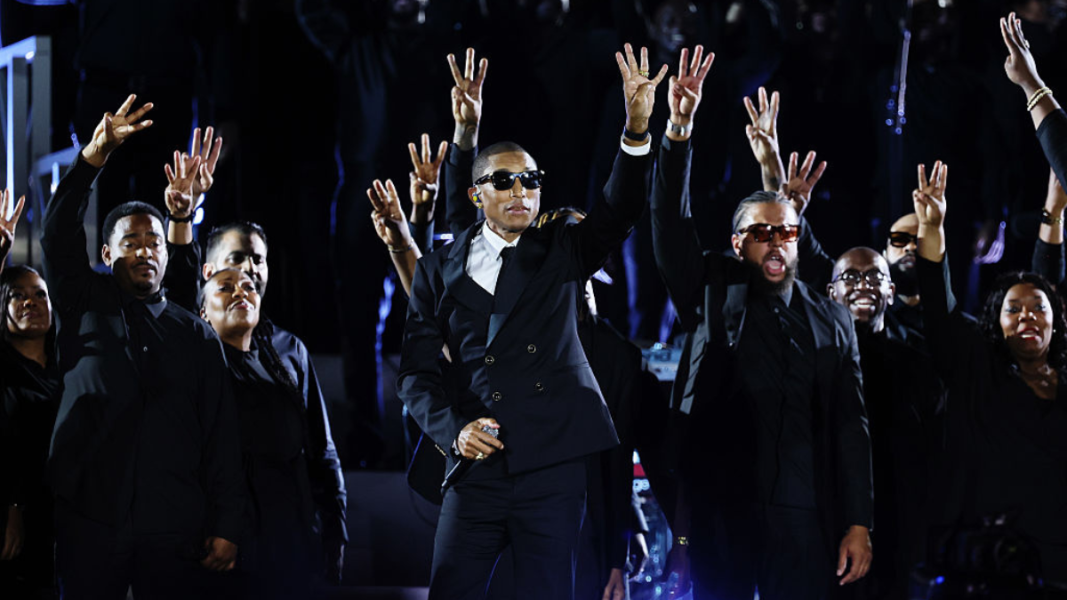
The blunder repeats: in December 2024, Pharrell Williams was the musical star of the reopening of Notre Dame Cathedral in Paris, five years after the fire that severely damaged it. There were criticisms then of the choice of a gospel choir and the not very Catholic atmosphere of the musical setting. It seems that Pharrell’s status as a best-seller with thirteen Grammys and creative director of Louis Vuitton carries more weight than connecting with the religion you’re trying to honor. Nine months later, he is commissioned for the first concert in the history of St. Peter’s Square, a responsibility shared with Adam Blackstone and Andrea Bocelli. Pharrell is Presbyterian, Blackstone Baptist, and Bocelli, the only Catholic. Needless to say, the Italian, who has already performed for three popes, provided the best moments of the night, without needing major innovations.
As a general assessment, the show was flashy, entertaining, and professional. The power of the international choir of 250 voices stood out, with a notable presence from the choir of the Diocese of Rome. The main flaw of the show was the secondary role of religiosity: many references to the ‘inner light’ of beings, to the need for justice to resolve conflicts, and to the lack of fraternity, but hardly any mention of doctrinal concepts. It could have been the party of an NGO, Oprah Winfrey’s birthday, or an anniversary of the European Union. What a waste, then, to use St. Peter’s Square in Rome as a simple photocall for a musical display with hardly any connection to the church that hosts it.
Andrea Bocelli, with his majestic voice, kicked off the night with great height, performing “Amazing Grace,” a universal hymn. It was composed in 1779 by John Newton, a rebellious teenager enlisted by his parents in the British navy to discipline him. He ended up being expelled, and his solution was to work as a slave trader, a job he abandoned upon discovering God, which led him to study Theology and become a priest. The lyrics convey that any sinner can be redeemed by the grace of the Lord. It is the most performed hymn in Anglo-Saxon churches.
Then came Schubert’s “Ave Maria,” a ‘lied’ (song) composed in 1825. Created with different lyrics, based on a Walter Scott adventure story, it gradually approached the Catholic prayer of the same name. It was the best of a night that was going to slide down the slope of the Afro-Protestant repertoire, from soul to gospel, passing through hip-hop. Bocelli also performed, with the Colombian star Karol G, the duet “Vivo por ella,” a beautiful piece of love that in the context of the concert seemed tailored to the Virgin Mary. The voices blended perfectly, due to the contrast of power and sweetness.
Many would be surprised by the discreet role of the urban star Karol G, who limited herself to this duet and one of her mid-tempos, “Hasta que me cure el cora.” The singer was the most criticized when the lineup was announced, as some feared a display of indecent trap or reggaeton. Her contribution, on the other hand, was to appear more covered than ever and whisper her best song of emotional self-care. What else could happen? Karol was not only the most applauded, but she starred in the image of the night, crying with her parents at the foot of the stage.
Then it was the turn of Angélique Kidjo, the star from Benin who gave an elegant and spirited performance of “La vida es un carnaval,” a hymn popularized by Celia Cruz. The scarcity of songs in Spanish (two and a half) may be surprising when it is the most used language in Christendom, but it is normal in a show produced by Disney in the purest American style, with the main protagonism distributed among the sparkling rap phrases of Pharrell, the soul of the overrated John Legend, and the robust but homogeneous gospel of the group Voices of Fire. Legend only rose a bit in the version of “Bridge over Troubled Water” by Simon and Garfunkel.
Other modern but insubstantial flavors were the K-pop of the Thai Bambam and the melodramatic hip-hop of Jelly Roll. Everything paled in comparison to the safe options of the “Magnificat” sung by the Italian tenors Il Volo or Bocelli’s “Domine Deus.” The best religious hymns from hip-hop were missed, for example the volcanic “Jesus Walks” by Kanye West.
Seen as a whole, it seemed like one of those shows to commemorate the struggle for Civil Rights, especially the speech by Graça Machel Mandela, who cited the dramatic moments of some African countries without specifically alluding to the genocide of Christians. Pharrell kicked off his first speech with the shout of “God is the greatest” but then got lost in disquisitions about sharing each one’s inner light while asking the 300,000 attendees to turn on the flashlights on their mobiles, like in any everyday concert.
The impressive drone show, forming the face of Pope Francis, the Holy Spirit in the form of a Dove, and Michelangelo’s Pietà, was one of the few reminders of the Catholicism of the occasion. I don’t think it’s too much to ask that for the next show more attention be paid to the doctrine and aesthetics of the church that sponsors it. Pope Leo XIV did not attend the gala and it was probably better that way.