


By Stephen P. White
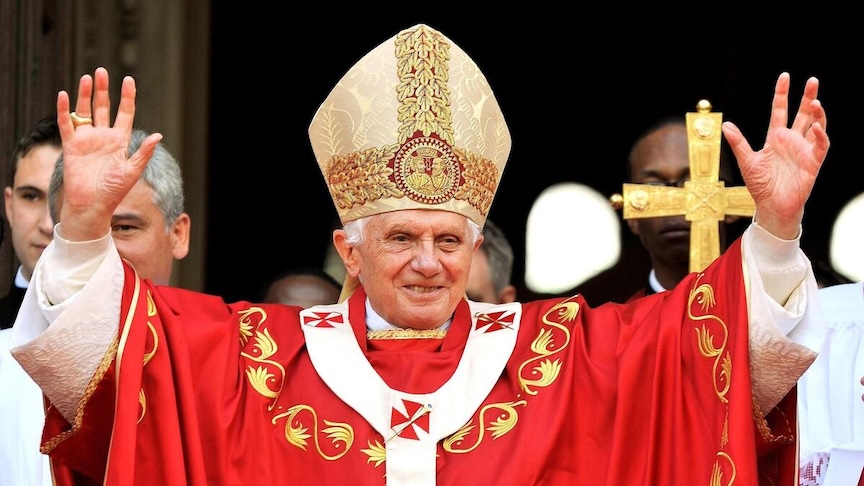
Fifteen years ago, in this same month, Pope Benedict XVI became the first pontiff to make a state visit to the United Kingdom. (John Paul II had made a pastoral visit in 1982.) It was a historic event, both for the Catholic Church in the United Kingdom and for the country itself. Nearly five centuries after Henry VIII broke with the Church, the Bishop of Rome was received by the Queen at Holyroodhouse, welcomed by the Archbishop of Canterbury at Lambeth, and invited to address British leaders and dignitaries in Westminster Hall, the same place where St. Thomas More was tried and condemned 475 years earlier.
The central act of the Pope’s visit was the beatification of John Henry Newman in Birmingham. Naturally, Newman had a prominent presence in the various speeches and homilies that the Pope delivered throughout his trip. It is worth revisiting some of those interventions by Benedict, not only because Pope Leo XIV’s recent decision to declare Newman a Doctor of the Church makes them especially timely, but because Benedict’s words, deeply inspired by Newman, have gained relevance over time.
In his homily for the Mass at Westminster Cathedral, Pope Benedict emphasized Newman’s enthusiasm for a solid and well-formed laity, and for the responsibility that all the baptized share in the Church’s mission. He quoted him with these words:
I want a laity that is not arrogant, nor reckless in speech, nor contentious, but men who know their religion, who enter into it, who know just where they stand, who know what they believe and what they don’t believe, who know their creed so well that they can give an account of it, who know enough of history to be able to defend it.
From this perspective, the faithful laity are indispensable, not only for the Church and its mission, but also for society as a whole. They are the principal means by which the Church acts as leaven in all areas of social and civil life. Newman’s vision, Benedict observed, finds an echo in the teachings of the Second Vatican Council, especially in Lumen Gentium.
And that vision of the laity is complemented by what Benedict called Newman’s “deeply human vision of the priestly ministry.”
In his speech to the leaders and dignitaries in Westminster Hall, Benedict established the link between the apostolate of the laity and a healthy and vigorous clergy. In fact, he insisted that the essence of the priestly vocation becomes clearer when the lay vocation is lived with fidelity and zeal.
Let us pray, then, that the Catholics of this land become ever more aware of their dignity as a priestly people, called to consecrate the world to God through lives of faith and holiness. And may this increase in apostolic zeal be accompanied by an outpouring of prayer for vocations to the ordained priesthood. For the more the lay apostolate grows, the more the need for priests is felt; and the more the sense of lay vocation is deepened, the more the proper role of the priest stands out.
This reciprocity between lay and clerical vocations is far from the zero-sum approach –so common in some sectors of the Church today–, which seems unable to imagine the relationship between laity and clergy except in terms of power.
A similar mentality also threatens public and civic life. As both Newman and Benedict understood, treating the relationship between faith and reason as an exclusive competition impoverishes both.
And here we come to the heart of Benedict’s speech in Westminster Hall: “The central question is this: where is the ethical foundation of political decisions?”
How can a society –especially a pluralistic society like that of the United Kingdom– aspire to answer fundamental political questions by excluding the light of faith from our deliberations on how we should live together? “If the moral principles that underpin the democratic process are determined by nothing more solid than social consensus,” Benedict warned, “the fragility of the process becomes all too evident; there lies the real challenge for democracy.”
The Pope argued that the Catholic tradition holds that “objective norms governing right action are accessible to reason, irrespective of the content of revelation.” Consequently, the role of the Church is not to impose those norms on the political community as if they could not come from another source, but to “purify” and “shed light” on the way in which rational debate should seek, discover, and apply objective moral principles. Religion performs a “corrective” function in the exercise of reason.
Significantly, Benedict also insisted that “distortions of religion arise when insufficient attention is paid to the purifying and structuring role of reason within religion.” In his defense of the mutual interdependence between faith and reason in Westminster Hall, the Pope did not mention Newman by name, but it is hard to think that he did not have him very much in mind.
And there are those who argue –paradoxically with the intention of eliminating discrimination– that Christians in public office must, at times, act against their conscience. These are alarming signs of a lack of appreciation not only for believers’ rights to freedom of conscience and religion, but also for the legitimate role of religion in the public sphere.
If only the Pope’s warning had been heeded.
In today’s United Kingdom, you can be arrested for a politically incorrect tweet. Or for praying silently too close to an abortion clinic. Reason, detached from the religious faith that should correct it, descends into absurd inhumanity. What can correct such absurdities?
Fifteen years ago, Benedict, through Newman, offered a firm answer: “A laity that is not arrogant, nor reckless in speech, nor contentious, but men who know their religion, who enter into it, who know just where they stand, who know what they believe and what they don’t.”
Let us pray for that leaven.
About the author:
Stephen P. White is executive director of The Catholic Project at The Catholic University of America and a fellow at the Ethics and Public Policy Center in Catholic studies.