


A guest comment by Martin Grichting
The state theorist Thomas Hobbes (1588-1679) was a realist. In Christian terms, it would be said that he took into account the nature of human beings, weakened by the consequences of original sin. That is why he not only popularized the ancient phrase «Homo homini lupus» (man is a wolf to man). In his work «Leviathan», he also shows why a state is necessary: without its restrictive power, the competitiveness and ambition of human beings would lead to a war of all against all. This is prevented by the strong state, the Leviathan, that «mortal god to whom alone under the eternal God we owe our peace and protection».
In «Leviathan», Hobbes also addresses the topic of counsel. Should a superior receive advice directly, in private or in public? For Hobbes, who has no illusions, it is clear: the monarch is capable of consulting anyone, where and when he wants, and listening in silence to the opinions of those who have more experience in the matter at hand. Therefore, the monarch should listen to his counselors individually, and not in public meetings. In the first case, he would know the opinion of several, while in the second, he would often know only the opinion of one. The members of a council were guided by those who were eloquent or powerful. To avoid being considered stupid, they often agreed with opinions they did not even understand. Many counselors put their own good before the common good. If they were listened to individually, this would be less harmful. Because, alone, the human being is more moderate. But when found in an assembly, individual torches flare up together, as if by a gust of wind, due to the eloquence of some, leading to the ruin of the state. Moreover, in public, some counselors mentioned things that had nothing to do with the topic, just to demonstrate their broad knowledge and eloquence. (Ch. 19 and 25).
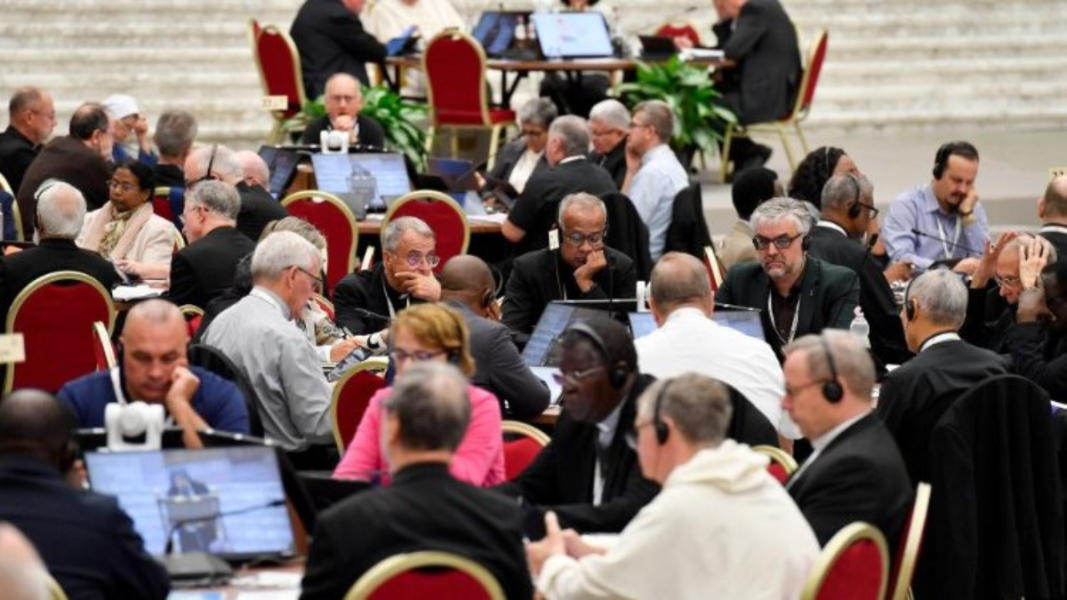
If one considers the synodalism with which the Holy See has flooded the Church for years, one must note that «the children of this world are more astute in dealing with their own kind than are the children of the light» (Lk 16:8). Because even if one does not want to attribute sinister intentions to synodal activity, but simply naivety, the negative dynamics against which Hobbes warned come to light: officially, superiors are advised, whether the Pope, the bishop or the parish priest. But in reality, one speaks with equals. One produces oneself and influences others in one’s own way, if possible also through the media. The last years have shown that for many it is not about the matter itself, but about their own matter. And the predictable behaviors of influence, manipulation and power games of pressure groups manifest themselves. Synodal events at the global, national, diocesan and parish levels are the catwalk for egocentrics, careerists and ideologues. They parade on the synodal runway, not to show the public their physical attributes from all angles, but their theological and intellectual skills, often only supposed. With their theories, they often sow confusion among the people of God and turn the Church into a parliament. The authorities naively assure that it is not so. However, synodal activities, if they still interest anyone, are understood in a parliamentary way by people accustomed to democracy.
Chapter IV of «Lumen Gentium» contains two sentences on the participation of some laity in the mission of the hierarchy (cf. LG 33). These sentences are the starting point for their synodal participation. But the Council speaks in Chapter IV of «Lumen Gentium» (according to the German translation) in 88 sentences of the mission of all laity in the family and in the bosom of the state, civil society, the economy, culture and the media. If it remains valid that Vatican Council II must be applied, should not synodalism be practiced and the mission in the world incumbent on all laity be promoted in a proportion of 2 : 88? However, since «Christifideles laici» (1988), little has been heard of the latter. Instead, the incessant Roman activism makes the laity understand that the fulfillment of their mission lies in synodalism. Little by little, the disturbing question arises: is there hidden behind the retreat to one’s own structures the admission that Vatican Council II is not applicable, at least with regard to the Church’s relationship with modernity, democracy and the society of free and equal people?