


THE THREE LIVES OF FRAY LOPE DE OLMEDO (XXXIV)
Pilar Abellán OV
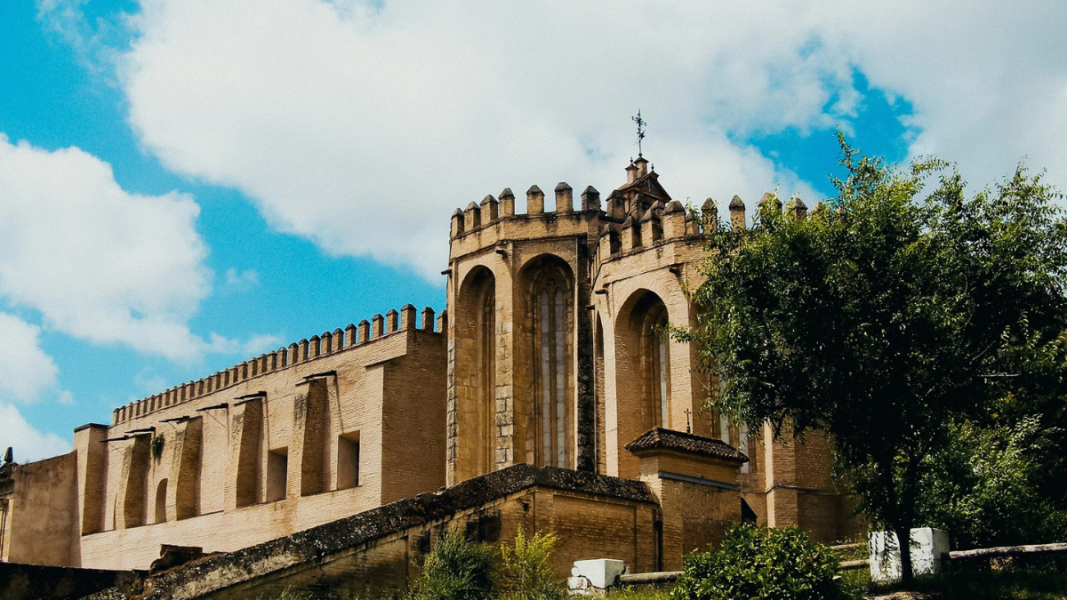
Passing by the town of Santiponce, arriving in Seville via the Vía de la Plata or the old road from Badajoz, one observes on the right hand side an imposing monastery-fortress. Perhaps you don’t know the name of that monastery, as was the case for me when, for years, I made that journey on various occasions. Little could I imagine that years later I would study it as the main monastery of Fray Lope de Olmedo in Spain.
It is the monastery of San Isidoro del Campo, which opened to the public on July 9, 2002, after a long process of restoration and enhancement of the medieval core.
We had already mentioned how the Cistercian monks who inhabited the monastery of San Isidoro del Campo were dispossessed by virtue of a bull granted by Martin V in 1429 at the behest of Enrique de Guzmán, Count of Niebla, and replaced by the Hieronymite hermits of Lope de Olmedo” (P. J. Respaldiza Lama, 1996. “El monasterio cisterciense de san Isidoro del Campo”, Laboratorio de arte #9, pp. 23 – 47). And today we are going to pause to review the history of this monumental complex from its foundation until the departure of the Cistercian monks first, and subsequently, the arrival of the hermit monks of Fray Lope de Olmedo.
The prestigious medievalist Martín Aurell, RIP, warned of two fundamental dangers in the elaboration of a historical biography: on one hand, psychologism, and on the other, the irrelevance of the character in the narrative of events. Do we run the risk of losing sight of Fray Lope de Olmedo if we delve today into the study of this magnificent monastery, given that the documents point to him having lived there for only a few months? I believe – and hope – not, because, although it is true that Lope’s passage through this monastery was fleeting, it was not the charisma he imprinted on it through his monks. «Charisma» in ecclesiastical terminology refers to the spiritual identity of a religious institute. In the case of the monastic order founded by Fray Lope de Olmedo, my impression is that, whether it had more or less human success, it is faithfully based on the way of following Jesus Christ according to Saint Jerome. And this is reflected in the architecture and monastic paintings.
Let us begin with the foundation of San Isidoro del Campo and its Cistercian period. Professor Pedro José Respaldiza Lama, in the Proceedings of the Congress held in 2002 with the opening of the monastery after the aforementioned restoration works, explains how San Isidoro del Campo is a monastic complex founded in the early 14th century with a funerary purpose, as a pantheon for the Guzmán family. It was first occupied by Cistercian monks. We reproduce the exact words of Professor Respaldiza Lama: “The origin of the monastery was linked to traditions and legends associated with Saint Isidore, the illustrious bishop of Seville, one of the pillars of medieval Western culture, whose figure was raised in the crusade of reconquest (the author calls it “ideological justification for the expansion of the Christian kingdoms”) toward the south of the Iberian Peninsula. The discovery of the remains of the Hispalis bishop in the place where the monastery was later built and their transfer to León recovers a route, the so-called Mozarabic Way that, starting from this place, reached Santiago de Compostela, the ancient Vía de la Plata of pre-Roman origin, which connected the Guadalquivir valley with the Cantabrian Sea.
San Isidoro del Campo was founded in the vicinity of ancient Italica, where according to tradition Saint Isidore of Seville had created a college and his remains were transferred after the Muslim invasion. Its character as a monastery-fortress might surprise at first, but this was common in the Middle Ages and has both symbolic and functional justification; first, because, at the end of the 13th century – beginning of the 14th, Seville was still in Muslim hands.
Alonso Pérez de Guzmán and his wife María Alonso Coronel founded the Monastery of San Isidoro del Campo in 1301, after Ferdinand IV granted the corresponding privilege in 1298. The monastery was given to the Cistercian monks of San Pedro de Gumiel de Hizán (Burgos) and its prior held not only spiritual power equivalent to that of a bishop, but also the temporal power of a feudal lord over his possessions, which included the town of Santiponce, located on the banks of the Guadalquivir. The Cistercian monastery has a marked fortified character, following the traditional scheme: around the cloister, the various dependencies and the church are articulated, in reality two adjoining ones, since Juan Alonso Pérez de Guzmán, son of Alonso Pérez de Guzmán, El Bueno, ordered the construction of one juxtaposed to the original. This foundational church would be reserved for monastic worship, while the other was open to the faithful.
The presbytery of the foundational temple, in addition to its liturgical function, served as a pantheon for the founders and their lineage. In the deed of endowment of the monastery, the burial of monks or any other person outside the family is expressly prohibited, and likewise that none of the descendants be placed between the altar and the founders: Alonso Pérez de Guzmán, El Bueno, and María Alonso Coronel. Thus, the presbytery and the nave of the temple were occupied by the tombs and slabs of the Guzmán family; until the beginning of the 17th century, due to the provisions of the Council of Trent, which safeguarded the preeminence of the liturgy, the tombs and effigies of the patrons were placed in lateral arcosolia and the other burials were removed, leaving the celebratory area free (Respaldiza Lama, P. J., 2004. “San Isidoro del Campo (1301 – 2002). Fortaleza de la espiritualidad y santuario del poder”, en Actas… pp. 243 – 262).
However, at the beginning of the 15th century, the Cistercian community of San Isidoro del Campo was going through a crisis. Fray José de Sigüenza states that monastic discipline had diminished among the Cistercians; and that disorder and frivolity had been introduced, “as often happens, not only in the Monastery, but also in the Church. For this reason, the pious Count of Guzmán, who cared for the good regulation of his Monastery, wrote to the Holy See to obtain the faculty to take it away from the Cistercians and give it to the Hieronymite Monks of the new Institute of the Venerable Lope (tom. 2 lib. 3 cap. 8 and Heliot, tom. 3 parte. 3 cap. 60). Norberto Caymi continues to explain the transfer of the monastery from the Cistercians to the hermit monks of Fray Lope as follows: “when Pope Martin V, who reigned then, saw the Count’s declaration, weighed his reasons and confirmed the truth of the matter, he rejoiced immediately. And soon Lope was put in possession of the Monastery by D. Alfonso de Segura, Dean of the Church of Seville. There Lope made a longer stay than in the Archbishop’s Palace (during his tenure as apostolic administrator of the diocese), attending with the greatest zeal he could to the government of the monks, who in great number had placed themselves under his discipline, reducing to a suitable form the things that had previously been left in a state of disorder, and making himself a living example of holiness not only for the religious subject to him, but also for the people of Seville, who never ceased to admire him wherever he was and in any ministry, and thus to look at him, who knew how to combine the observance of the cloister with the manners of an archbishopric.”
As is usual in historiographical and documentary accounts about Lope, we find an inaccuracy in Caymi’s narration; because although the monastery was ceded to Fray Lope de Olmedo by a bull of 1429, he could not take possession of it until 1431, as we have already mentioned. Professor Respaldiza Lama explains this in the Proceedings of the 2004 Congress (pp. 251ss): “the Cistercian monks abandoned the cenobium on September 27, 1431.” If this date is correct, we can hypothesize a possible solemn entry of the Hieronymites into the cenobium three days later, on September 30, the feast of Saint Jerome, a date with high symbolic content for the monks.
San Isidoro del Campo was an important monastery, near the city of Seville. Nothing to do with the small building of San Isidoro de Acela, hidden in the Sierra de Cazalla, the wilderness that Fray Lope wanted for his monks. Professor Respaldiza Lama aptly mentions that “the identification of this obedience with the monastery was such that from their entry into San Isidoro del Campo (the Hieronymite hermit monks) they would be popularly known as the isidros”; a denomination that can be found very frequently in historiography when referring to the monastic institute of Fray Lope de Olmedo in Spain.
The arrival of Fray Lope’s Hieronymites at San Isidoro del Campo marked the beginning of a long period of splendor. Proof of this, Professor Respaldiza Lama states, “was the expansion of its proportions, differentiating around the foundational core various areas, such as the Great Cloister with the individual cells, the procurator’s office, the pharmacy, etc.”
Let us pause briefly to emphasize the theme of the individual cells of the Hieronymite monks. Unlike the Benedictines (and Cistercians), who slept in common dormitories; or the Carthusians, who did so in small independent buildings, the Hieronymite monks were characterized (whenever they could, as many houses they received were already built) by spacious individual cells distributed around a cloister, underscoring the eremitic dimension of their monasticism.
“The Courtyard of the Evangelists or of the Guesthouse – continues Professor Respaldiza – had a marked representational character. With its pictorial decoration, the initial transformation of the monastery began; in it is shown the link between the patronage of Enrique de Guzmán and the Hieronymite order, with his heraldic emblems flanking the scene of Saint Jerome dictating his teachings to the monks. The decoration was completed with figures of various saints, Mudéjar compositions of lacework, cloths with acanthus scrolls, and the scene of the Tree of Life.
The systematic study of the Sacred Scriptures, following the example of Saint Jerome, was one of the objectives promoted by Lope de Olmedo’s “hermit” Hieronymites – comments Respaldiza Lama-, which in the long run, due to the Protestant heresy of sola scriptura, led to a (unfortunate) Protestant focus emerging in San Isidoro at the beginning of the 17th century, which resulted in the translation of the Bible into Castilian by Casiodoro de Reina and Cipriano de Valera, isidro monks.
The refectory is located in a rectangular space that occupies the western wing of the cloister, corresponding to the primitive work of the 14th century, which follows the postulates of the Burgalesa Gothic architecture so common in Seville. On the walls of ascetic architecture and Cistercian spirit, the Hieronymite monks deployed an extensive iconographic program at the end of the 15th century, decades after Fray Lope’s transfer.”
Continuing with the modifications to the cenobium’s structure introduced by the Hieronymites, in the chapter house the second floor was removed, where the Cistercian common dormitory had been, and the pictorial decoration dedicated to the life of Saint Jerome was carried out, of which the scenes of The Imposition of the Cardinal’s Hat, the Departure to the Holy Land, Saint Jerome Dictating to the Monks, The Appearance of the Lion, and The Theft of the Donkeys have been preserved, framed by a Gothic architectural structure.
More information on the mural paintings of San Isidoro del Campo in this article by Professor Respaldiza Lama.
It is important here to mention that, obviously, all these works and paintings took place in the second half of the 15th century, once Fray Lope had already passed away. Therefore, although it is true that Lope lived in the cenobium for a very brief period, no more than a few months, as we will now say, the charisma or spiritual identity of his institute transformed the monumental complex, imprinting its spiritual seal on it for one hundred and fifty years (until Philip II ordered in 1567 that the Order of Saint Jerome absorb the Spanish monasteries of Fray Lope de Olmedo).
Regarding Fray Lope’s departure from the Archdiocese of Seville’s monastery (and therefore from San Isidoro del Campo), José Antonio Ollero Pina considers that “probably, Fray Lope de Olmedo still endured the government of the diocese until the last months of 1432”: “The pious version says that he resigned and Fray José de Sigüenza states that he retired to San Isidoro del Campo. However, the causes of his withdrawal must have gone beyond his own intellectual concerns. The requests for help to the pontiff a little more than a year after his appointment were a confession of his own weakness, and with Anaya apparently eliminated, his replacement was something that was already decided. Seville was too appetizing a piece for him to remain in it for long” (Ollero Pina, 2007, p. 159 – 160).
However, it is not unlikely, although Ollero Pina considers that Fray Lope was in Seville until the end of 1432, that he left earlier. Governing the Order and the Archdiocese must undoubtedly have been too burdensome, especially reading from Ollero Pina the continuous problems caused by the supporters of Diego de Anaya. Having died his friend Martin V in February 1431, who appointed him to the position, Lope submitted his resignation to his successor, Eugene IV, in 1432 and returned to Rome, to the general house of his order, the monastery of San Alejo and San Bonifacio.
You can follow the biographical series on Fray Lope de Olmedo here.