


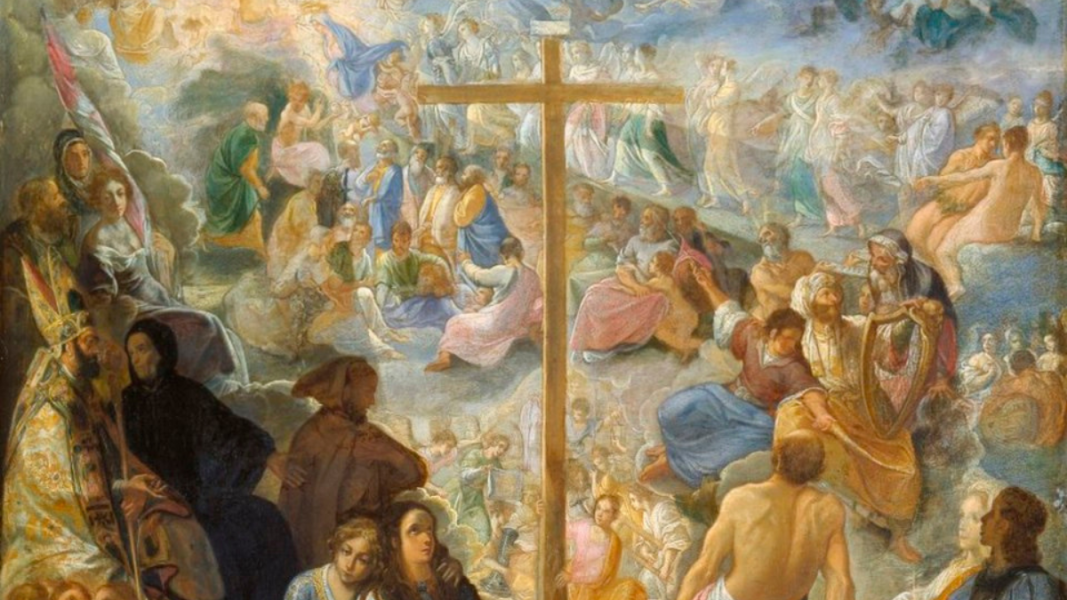
Every September 14 the Church celebrates the Exaltation of the Holy Cross, remembering the wood on which our Lord Jesus Christ died and from which redemption sprang for all humanity. As St. John Paul II taught, it is the cross “in which one dies to live; to live in God and with God, to live in truth, in freedom and in love, to live eternally”.
The cross is not an ornament nor a mere cultural symbol: it is the sign of divine love poured out without measure. There Christ conquered sin and the power of death, opening the door to eternal life.
History of the feast
Tradition dates this feast back to the 4th century, when Saint Helena, mother of Emperor Constantine, after a long search in Jerusalem, found the wood on which the Son of God died.
In the year 614, the Persians took it as a trophy of war, but in 628 the Byzantine emperor Heraclius managed to recover it and return it to Jerusalem on September 14. From then on, the date was fixed as a liturgical feast.
When the Church celebrates the Exaltation of the Holy Cross, it does not worship a material object, but recognizes in it Christ the Redeemer himself. As the Second Council of Nicaea reminds us, the veneration of the Cross is directed to Him who gave his life on it for our salvation.
Emperor Heraclius
Tradition tells that Heraclius wanted to carry the holy wood dressed in all his imperial pomp, but the weight of his ornaments prevented him from advancing. Archbishop Zachary reminded him that Christ carried the cross in humility and poverty. Then, stripping off his royal garments, barefoot and simple, he was able to carry it in procession, showing that only in humility can one follow Christ.
Subsequently, the relic was divided: fragments arrived in Rome and Constantinople, while the rest was distributed to various churches around the world as relics of the True Cross.
«Ave crux, spes unica»
The Exaltation of the Cross reminds us that the Christian mystery is not based on the power of the world, but on the glorious weakness of the Son of God who “humbled himself to death, even death on a cross” (Phil 2:8). From that apparent failure sprang the definitive victory over sin and death. Therefore, the liturgy rightly sings: “Hail, O Cross, our only hope”.
Honoring the Cross is, therefore, confessing the Catholic faith in the redemption: believing that only in it there is life and hope. In the face of a world that seeks to eliminate Christian signs, the Church proclaims firmly that the Cross remains the standard of Christ’s victory, the sign of protection against evil and the sure path to salvation.