


By David Warren
Perhaps it’s a lack of diplomacy on my part, but my attitude toward most contemporary political controversies could be summed up like this: “You’re crazy!”
This expression implies that there’s no point in continuing the discussion. After all, the opponent will hardly admit to suffering from a mental illness—though I myself have acknowledged that we all, including me, are a bit unhinged these days.
That is, in fact, the current state of political debate. No matter what topic we start with, we soon find ourselves discussing everything that has ever been debated in politics; and of course, we are not well informed about everything that has ever been debated.
Politics even imposes itself on our most specialized discussions. Religion, for example—whether Christian, Jewish, Islamic, or Other—has been reduced to a dark corner of the map of controversies.
Wealth and ostentatious materialism are displayed without shame, but thanks to socialism, they are politicized by both the left and the right.
Professional sports can, for a brief moment, stand out from the darkness, and I have witnessed moments when a joke is so universally understood that every conscious being laughs. They are moments of relief from the condition that enslaves us—even with those we agree with.
I wonder if monastic life is very different today when I discover that almost every monk or nun can be contacted by email.
Some, very disciplined, have apparently learned “the art of silence”, at least in matters that don’t concern them; for, in an extra-religious way, they realize that almost nothing is anyone’s business.
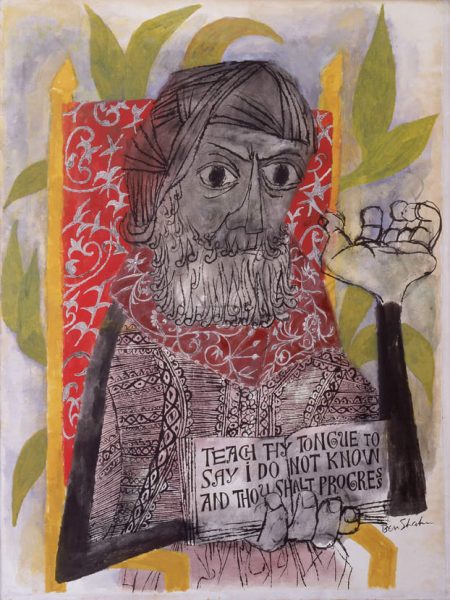
Truly, I think of an old Jewish friend, of whom I couldn’t be sure he was a friend, even while playing chess with him. It wasn’t that he was silent—though he was, mostly—but that he seemed to have no demonstrative opinions. At most, one could get directions from him to some street, and occasionally a mysterious quote from Maimonides, or from the Mishnah, while moving his rook. Or maybe it was Kafka.
My admiration for this “Eric the Blessed” (as I called him, parodying his given name) lay in his instinct for self-preservation, in the highest conceivable sense. Physically threatened or not (and Jews often are), he never deviated from what he believed to be unnuanced truth.
This I deduced. Eric wouldn’t have stated such a thing. I think he would assume that, so to speak, every statement is false.
Faith, too, I would say, is not a statement. It precedes any verbal formula, though words may have contributed to it. In this sense, faith is very different from reason, which can usually be expressed; sometimes even mathematically.
But returning neurotically to politics: an opinion can be based on reason, or employ it in some way, without becoming reasonable in itself. One must leap into the ether, for faith must also be consulted.
There are no, as Christ showed in words and deeds, simplistic certainties here, where the sun does not always shine visibly. What we see, we see only for an instant, and then it is covered by the night. What we describe can remain apparent only momentarily.
And yet, the strange thing—for those who consider it strange—is that truth can only be a function of freedom, and freedom only a function of truth, in our twilight world. Every attempt to impose our opinions is a betrayal of both truth and freedom. It is a small declaration of war against sanctity; or a large one.
It was for that reason, I believe, that Eric limited himself, at most, to ironic observations; and to gentle irony. Because he didn’t try to be witty. He only sought to be courteous when asked for an opinion.
A world composed exclusively of Erics might not be intelligible to most of the characters that populate this world, and yet, there is something recognizably “Eric-like” in all our best moments.
Curiously, those moments occur when we seek the truth, in big ways or small; though, as I believe Maimonides said, there is no such thing as a small truth. Because every truth is connected, as reason and revelation are connected, and as biblical teaching is linked to Aristotle’s philosophy.
Eric’s silence did not convey the typical humility before “the infinity of things.” It was an obedience “compelled” by nature and its Lord, in the voluntary form of a free man, and of his own courage.
We are not so clever, nor so independent, even when we try to act in our own political interest. We cannot perceive the interrelations or “correspondences” that silent contemplation begins to reveal: the extraordinary detail of the world that is being created, in which every particle has meaning.
I say “is being created,” and not “was created,” because the truth is that it is being created, in every infinitesimal instant, ceaselessly.
Truth, like the world, and like the possibility of freedom, has never disappeared nor will it disappear. This too is implicit in all of Creation, and we can know it just as we know that we exist.
Eric, an American, had a close American friend named Rob, who was Catholic and educated at Notre Dame (when that still meant something). He particularly enjoyed his company, together or separately; for being so alike, they were wonderfully different. Their friendship offered access to a strange society, in which truth came out of hiding and could be found freely.
As Goethe said about that Zwinglian, Lavater:
“Truth always strikes us as something totally new; and when one encounters a completely truthful man, it feels as if one has just landed in the world for the first time.”
Truth is rarely greeted as a tangible incarnation, but as a spiritual immanence that induces harmony.
Goethe, again:
“It is simple and unpretentious, while error offers opportunity to waste time and energy.”
About the author:
David Warren is former editor of the magazine Idler and columnist in Canadian newspapers. He has extensive experience in the Middle East and Far East. His blog, Essays in Idleness, can be found at: davidwarrenonline.com.