


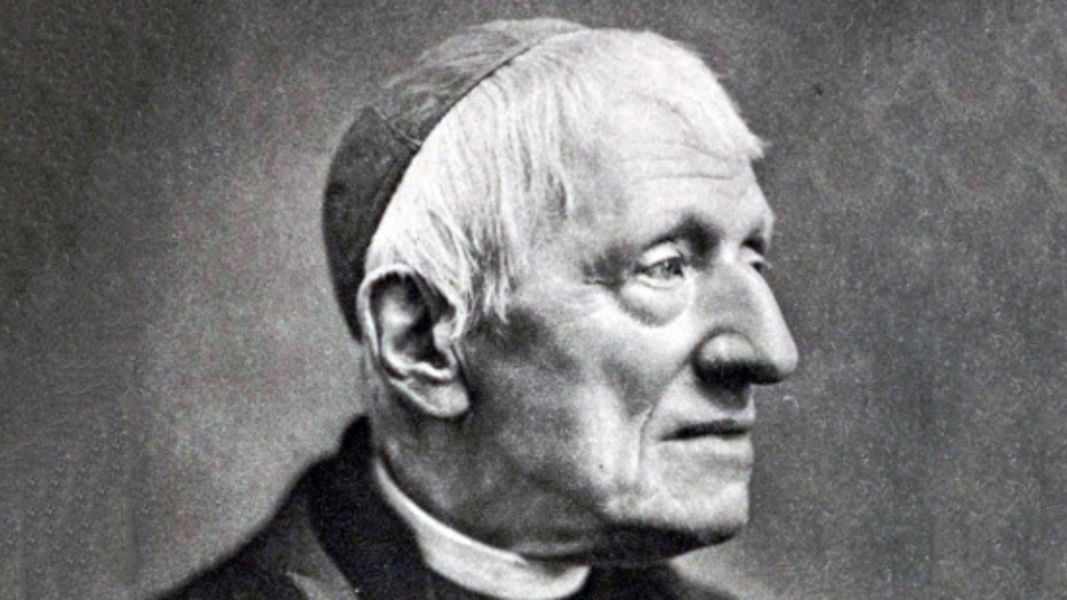
By: Tomás Salas
The new saint who takes up a position in the exclusive club of the Doctors of the Church, Saint John Henry Newman, is a convert. This also includes him in a club of illustrious masters of thought and word: Paul Claudel, Chesterton, André Frossard, Papini, Edith Stein, García Morente, and no less than two giants like Saint Augustine and Saint Paul.
Newman’s conversion has a special character. It is not a sudden flash, like in Claudel, Morente, or Saint Paul, but a process of long duration and gradual, slow, progressive evolution. Each stage builds on the previous one and little by little arrives at full Catholicism, which occurs officially on October 9, 1845, in Littlemore, at the hand of the Italian priest Domingo Bariveri.
But it could be said (something that may seem strange, but nothing is usual in Newman’s case) that he spent his whole life preparing to enter the true Church. What’s more: his writings and his life give the impression that he always considered himself Catholic, that he was Catholic «in potency» and that his entire gigantic spiritual and intellectual effort in life was nothing more than a process to bring that «potency» to «act.» «On the occasion of my conversion -he writes in his Apología pro vita sua– I was not conscious of any change in thought or feeling taking place in me with regard to matters of doctrine.» However, he acknowledges that he experienced «a great change in my way of viewing the Anglican Church,» which, for him, is part of the Catholic Church. «For the first time I looked at it from the outside (…) and saw it as a mere national institution.»
The process begins from his youth. The young Newman is steeped in humanistic culture, but also in the secular literature of his time; he has read Paine, Hume, Voltaire and thought: «How dreadful, but how plausible that is!» But, in 1816, at the age of 15, he experiences what he calls his «first conversion» (Apología). He arrives at the conviction that beliefs cannot be personal opinions or feelings, but «a precise creed.» He comes to understand what a dogma is and recognizes that «those ideas have never been erased or clouded from me» (Apología). Along with those certainties, he discovers that it is God’s will for his lifelong celibacy.
In that process, personal, sentimental factors, and historical context act, but it has an intellectual component that is basic; in this, he resembles Edith Stein. His whole life is an eagerness to pursue the truth. «My desire -he writes- has been to have truth as my main friend.» An honest, relentless eagerness, without falling into a priori assumptions or prejudices (not even religious ones), which are so common in the intellectual world.
The Anglican world in his time presented a diversity of positions sometimes very distant. Newman positioned himself in the so-called High Church, a movement that today we would call more elitist, both in the liturgical and intellectual aspects. They are close to Catholicism (although they reject some fundamental points, with nuances) in many aspects and distant from an evangelical Protestantism, more popular, more subjectivist, less institutional. In fact, they considered themselves a «third way» between papal Catholicism and evangelical Protestantism.
Placed in this context, he advances toward the truth relentlessly, but painfully. His first work (apart from his sermons and letters), The Arians of the Fourth Century, is a study of that moment of great crisis in Christianity, with the Council of Nicaea and the giant figure of Saint Athanasius. Newman glimpses that those doctrines on the nature of Christ and the Trinity were part of the apostolic tradition and had been entrusted to the Church. He writes a forceful phrase, which can be a refutation of Protestant individualism and anti-dogmatism: «it was a matter of facts, not opinions» (The Arians). Note that we are in 1833, 20 years before his conversion.
This spiritual evolution, but markedly intellectual, takes place not without personal upheavals. The Anglican Church is his world, where his friends and faithful are. The academic and religious environment of Oxford is something irrenunciable for Newman. He knows that, in this church, he is a prominent figure, prestigious for his knowledge and for the impeccable purity of his life, and that his move to the Roman Church is going to cause pain and dismay in many. On the other hand, he is aware of the shortcomings and contradictions of the Catholic Church of his time, in which he has, after his conversion, some problems. But none of these obstacles keeps him away from that passion for the truth.
In this case, we have the luck of being able to follow this delicate process step by step, explained with meticulous detail, in the great mass of his writings, especially in his Apologia. Only in Saint Augustine’s Confessions is there a conversion process so minutely explained, although Saint Augustine also focuses on biographical and historical aspects and the Apologia is more of a spiritual autobiography. These two books, along with the Life of Saint Teresa, are the three peaks of authors who have shared their profound religious experience.
The vocation of knowing as a continuous and powerful impulse is what moves Newman. Knowing not as mere useful knowledge or as erudition, but as an element that gives meaning to life, as a necessity of the spirit, which colors not only knowledge or reason, but all the powers of the soul. Could we speak here of wisdom as a gift of the Holy Spirit?
There are doctors to whom tradition has attributed some significant nickname. Saint Thomas, the Angelic, Saint Bonaventure, the Seraphic, Saint Augustine, the doctor of Grace. The qualification of Doctor Sapientiae might suit Saint Henry Newman.