


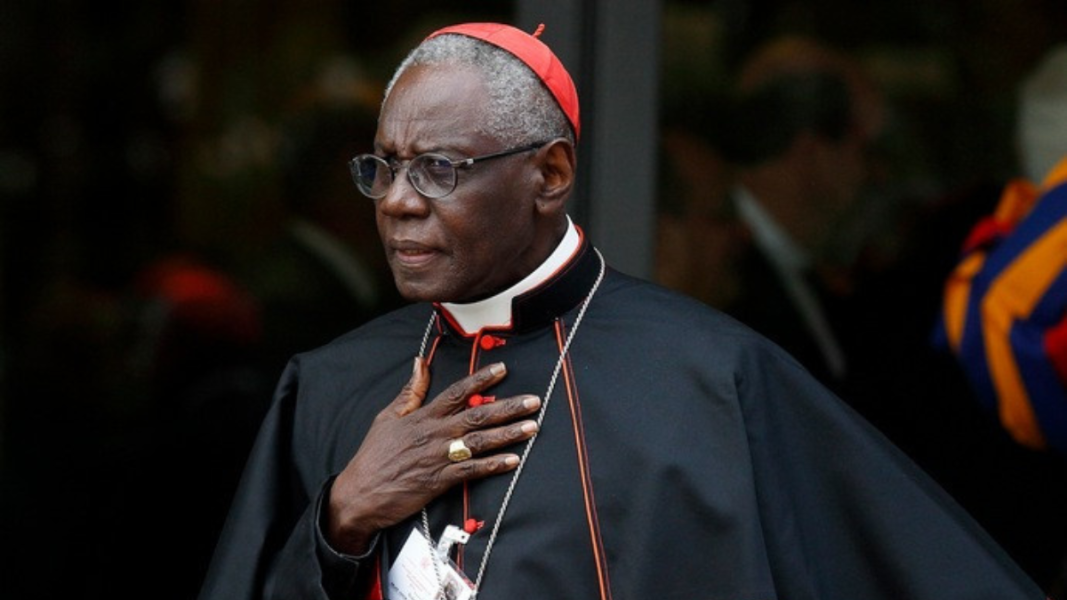
In an interview granted to the Italian media outlet Avvenire, Cardinal Robert Sarah, emeritus prefect of Divine Worship and the Discipline of the Sacraments, reviewed his life and his vision of the Church. The African cardinal expressed his deep trust in the new Pope, Leo XIV, and at the same time launched direct criticisms at some recent directions in ecclesial life, such as the declaration Fiducia supplicans or the restrictions on the Mass in the traditional rite.
«Pope Leo XIV —Sarah affirms— is bringing back the irrenounceable centrality of Christ. He reminds us that without Him we can do nothing: neither build peace, nor edify the Church, nor save our soul». In his words, the new Pontiff stands out for an intelligent attention to the world, «always in a spirit of listening and dialogue, but with a firm rooting in Tradition». For the cardinal, this fidelity is not an aesthetic detail, but the guarantee of continuity with Revelation and with the very foundations of the Second Vatican Council.
A life marked by the Church and the mission
Sarah recalls with gratitude having collaborated with great figures of the Church: Saint Teresa of Calcutta, Saint John Paul II, Benedict XVI, and Pope Francis himself. Born in Guinea, he was ordained a priest and then archbishop in his country, until Saint John Paul II called him to Rome as secretary of the Congregation for the Evangelization of Peoples. Benedict XVI created him a cardinal and appointed him president of the Pontifical Council Cor Unum. Later, Francis appointed him prefect of Divine Worship, a position he held until 2021.
After the election of Leo XIV, the Pope chose him as his special envoy to the shrine of Sainte-Anne-d’Auray, in France, to commemorate the 400th anniversary of the apparitions of Saint Anne. Sarah, however, downplays his importance: «Every day there are much more relevant news for the Church. The essential is Christ and his message, not the figure of a cardinal».
Unity in the face of divisions
Asked about Leo XIV’s emphasis on ecclesial unity, Sarah warned against two opposing visions that harm the Church: on one hand, those who want to dilute Tradition in an unconditional opening to the world; on the other, those who conceive Tradition as something rigid, fossilized, alien to history. «Both postures are ideological —he stated—. The mission of the Church is unique and cannot be fulfilled except in communion. The diversity of charisms is a richness, but everything must be rooted in unity».
The cardinal denounced that the weakness in the Christian proclamation comes from the lack of courage of some pastors:
«The Church has not abandoned man, but some Christians have, when they have been ashamed of Christ and have reduced faith to mere social promotion».
The West without God
Sarah has just published his book Dio esiste? (Does God exist?), in which he addresses the spiritual crisis of the West. «Today the idea dominates that one can do without God. Man, after dethroning him, has sat in his place, pretending to create a new order that denies the one God established». He recalled how Benedict XVI invited people to live etsi Deus daretur, «as if God existed», even for non-believers, because the reality of the divine presence cannot be ignored without falling into dehumanization.
For the cardinal, modern idols —success, power, wealth, the possession even of people— cannot fill the existential void. «God is not an idea or an emotion, but a certainty: the Son of Man has really existed and continues to dwell among us. The Incarnation is a fact. Even today it is possible to encounter Christ, recognize him, and even give one’s life for Him».
Curia, synodality, and traditional Mass
On the reform of the Curia, Sarah emphasizes that the Church belongs to Christ and the Pope is only his humble servant: «Structures are necessary for the mission, but always at the service of the Risen One». Regarding synodality, he warns of the risk of turning it into an ideological end. «Communion is the end; synodality is only a means, a style of walking together. Communion, on the other hand, is hierarchical because that is how Christ wanted his Church».
In the liturgical field, he was very clear: «A rite is not invented in an office, it is the fruit of centuries of lived faith. I wonder if a millennial rite can be prohibited. The diversity of rites has always been a richness for the Church. And if liturgy is the source of theology, how can access to ancient sources be impeded? It would be like prohibiting the study of Saint Augustine to understand grace or the Trinity».
Criticism of Fiducia supplicans
One of the most forceful moments of the interview was his assessment of the declaration Fiducia supplicans, which allows blessings for couples in irregular situations, including homosexual ones. «I hope it can be better clarified and reformulated. It is a theologically weak and unjustified document. It puts the unity of the Church at risk. It is a text that must be forgotten».
Witness between Africa and the West
On his role between continents, Sarah defines himself not as a bridge, but as a witness. «To the North, sated and desperate, I want to remind it of the deep reasons for living and dying. To the South, which preserves hope but suffers serious problems, I want to offer encouragement». He highlighted that Africa can bring to the universal Church freshness, enthusiasm, and genuine faith, although it is paying a very high price in blood: «The martyrdom of so many Christians will be fruitful, seed of new believers».
At the end of the interview, reviewing his life, Sarah emphasized with emotion two essential moments: having been born into a Christian family and having received the gift of the priestly vocation. «There everything changed. A love story began that will never end and a fascinating and demanding mission: to be alter Christus, to pronounce “This is my Body” and “This is my Blood” with all the responsibility and grace that entails».