


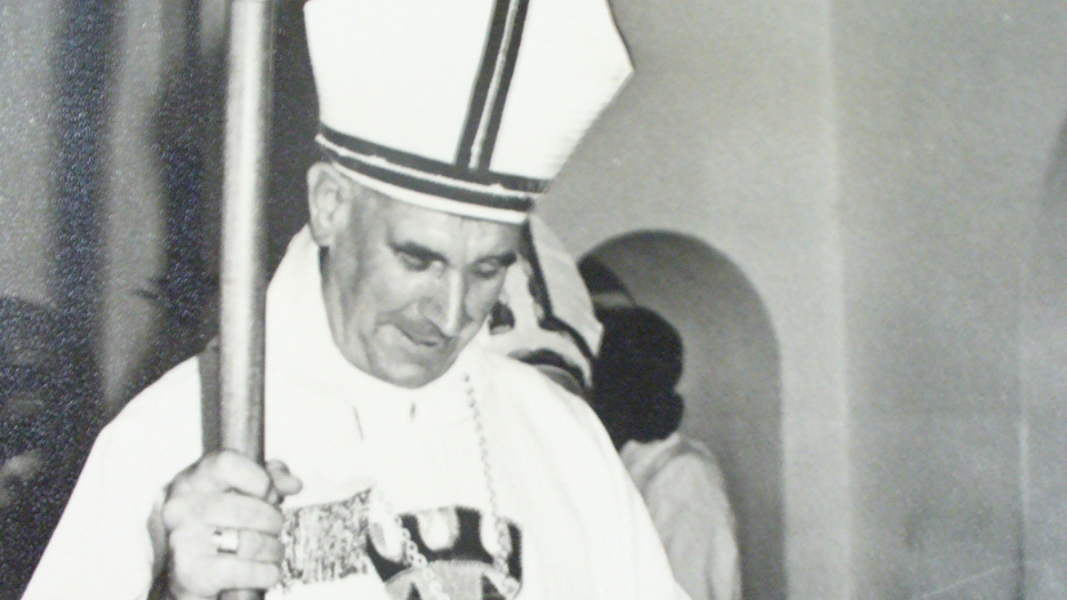
The Archdiocese of Asunción has officially opened the cause for beatification and canonization of Mons. Pedro Shaw, known throughout Paraguay as “Pa’i Puku”. The edict published on September 4, 2025, by the Archdiocese marks the formal start of this process, which seeks to verify the fame of holiness of a pastor who dedicated his life to the Paraguayan Chaco. The news comes in the context of the centenary of his birth, celebrated on September 6 of this year, and confirms the deep-rooted presence of his figure in the faith of the people.
Childhood and missionary vocation
Pedro—or Piet, as he was known in Belgium—was born on September 6, 1925, in Ghent, son of Gustaaf Edmond Constant Shaw and Mathilda de Andriessens. He was the third of five siblings: José, María, Pablo, and Teresa. The entire family was deeply Catholic, and from childhood he showed his desire to be a missionary. He completed his studies at the Sint Lievens College in Antwerp, and upon finishing, he joined the Congregation of the Oblates of Mary Immaculate (OMI), known for its dedication to difficult missions.
On September 7, 1945, he took his habits in the OMI novitiate in Korbeek-Lo, making his first religious profession in 1946. He studied philosophy from 1946 to 1948, and theology from 1948 to 1951 at the scholasticate in Gijzegen, and on September 30, 1951, he was ordained a priest by Bishop Karel-Justinus Calewaert of Ghent.
Arrival in the Chaco and the birth of Pa’i Puku
On March 8, 1952, he received his obedience to work in the Vicariate of Pilcomayo, and he arrived in Paraguay on December 16 of that same year. In January 1953, he moved to Benjamín Aceval, in the Lower Chaco, from where he worked as an itinerant missionary until 1965, visiting ranches and indigenous communities. His way of living, dressing, speaking, and sharing the life of the Chaco people made him one among them, and thus his popular nickname was born: “Pa’i Puku”, the “big priest.”
In 1962, he conceived the idea of founding a new apostolic center in the Chaco. With the donation of a plot of land at kilometer 128 of the Transchaco Route, he built a school-boarding house for Chaco children. On June 1, 1965, it opened its doors with 25 students, eleven of them boarders. There, Pa’i Puku established himself as the parish priest of the Centro María Medianera until 1973.
Pastor in Puerto Elsa and bishop of Pilcomayo
In 1973, he was appointed parish priest of Puerto Elsa (now Nanawa), a border town opposite Asunción, where much of the population lived from smuggling. His pastoral work amid a difficult social reality was a testimony of closeness and evangelical firmness.
On February 21, 1981, he was appointed Apostolic Vicar of Pilcomayo and consecrated bishop on April 22 of that year. His episcopate was brief, but it deeply marked the Church of the Chaco, to the point of consolidating his fame of holiness among the faithful.
Death and legacy
On June 21, 1984, at the age of 58, he died tragically in a traffic accident at kilometer 28 of the Transchaco Route, in the Remansito area, while heading to fulfill his pastoral mission. He was buried in the old Catedral San Miguel de Mariscal Estigarribia, seat of the Vicariate. The place of his death became a site of pilgrimage and prayer, and his memory remains alive in the Paraguayan people.
Opening of the cause
The edict from the Archdiocese of Asunción invites the faithful to present testimonies, documents, and writings attributed to Mons. Shaw that may help the tribunal in its discernment. It will remain on display in the Metropolitan Cathedral for three months. The process has the support of the Congregation of the Oblates and the faithful people, who consider Pa’i Puku as a model of simple, incarnate holiness deeply close to the people.
The opening of the cause for beatification of Pa’i Puku is a historic step for the Church in Paraguay. His life summarizes the missionary vocation in its most radical form: leaving everything to become one with the people served. His example challenges today a Church called to go out, to become incarnate in the peripheries, and to offer the Gospel with simplicity and fidelity.