


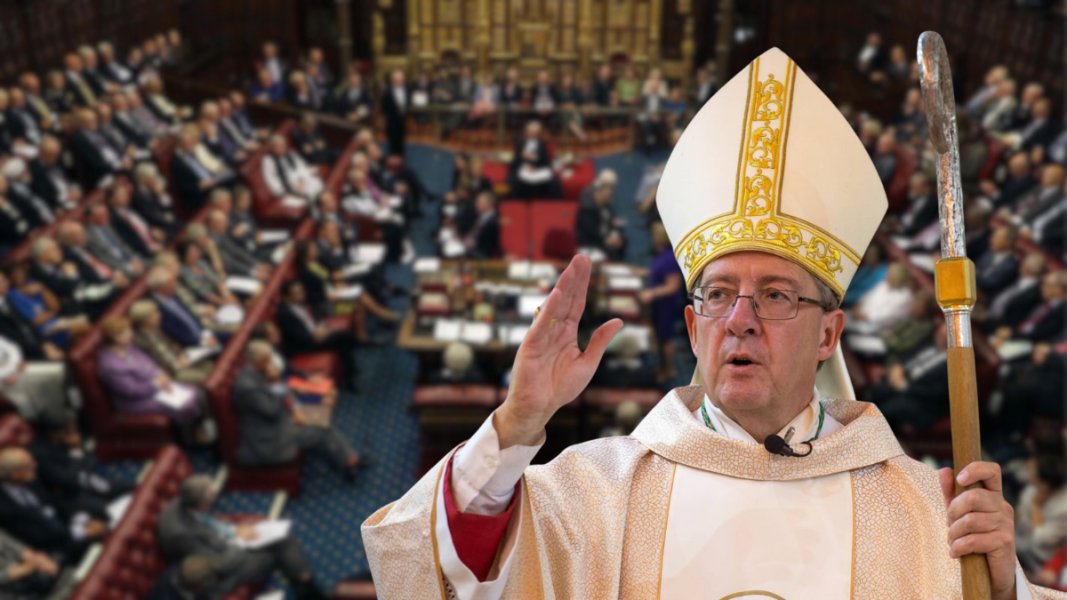
This 12 September, the House of Lords examines the Terminally Ill Adults (End of Life) Bill, which seeks to legalize assisted suicide in England and Wales. In an official statement issued by the Catholic Bishops’ Conference of England and Wales, Archbishop John Sherrington reiterated the Church’s opposition, warning that the law “remains impracticable and puts our healthcare institutions, professionals, and patients at risk”.
Risk to Catholic Hospitals and Hospices
The prelate emphasized that the proposal threatens the mission of hospices and nursing homes that, due to ethical principles, could never facilitate assisted suicide. “A right to die granted to individuals will become a duty for hospices and nursing homes to facilitate it,” he warned alongside Cardinal Vincent Nichols.
The fear is grounded in Article 42 of the bill, which mandates that “voluntary assisted dying services must exist in England and Wales organized under state regulations.” This point implies that medical institutions, including Catholic ones, could be pressured to enable spaces or procedures contrary to their Christian identity.
An Insufficient Conscience Clause
The legal text provides in its Article 31(1) that “no person is obliged to participate in assisted dying.” However, in section 31(2) it adds that objecting professionals must refer the patient to someone who can provide them with information and access to the process.
This obligation confirms what the archbishop pointed out: the conscience clause is not full, because “many doctors, in fact, will not be able to exempt themselves, having to direct patients to information or preliminary consultations”.
Risk to the Most Vulnerable Patients
The definition of “terminal illness” in Article 2(1) encompasses any adult diagnosed with a condition “that is likely to cause their death within six months.” This breadth, the bishops warn, leaves seriously ill people, but still capable of living with quality and care, at risk of feeling pressured to opt for death.
Archbishop Sherrington recalled that in countries like Canada, legalization began with limited criteria, but “quickly expanded to non-terminal patients and people without mental capacity”.
Palliative Care at Risk
The bishops insisted that the priority must be to ensure access to palliative care, and not weaken it. The bill mentions the need to assess the impact, but does not require improving its funding or provision.
“The inevitable result will be that, where palliative care is lacking, patients will feel pressured to end their lives,” Sherrington noted.
Call to Prayer and Action
The Catholic Bishops’ Conference statement concluded with a call to all Catholics: “We continue to call for prayer and action. I urge you to contact members of the House of Lords and, in particular, to share your personal or professional experiences on this important matter.” Let us remember the words of St. John Paul II in the encyclical Evangelium Vitae (n. 81):
«Human life, a precious gift from God, is sacred and inviolable, and therefore, in particular, procured abortion and euthanasia are absolutely unacceptable; human life must not only not be suppressed, but must be protected with the utmost loving care.»