


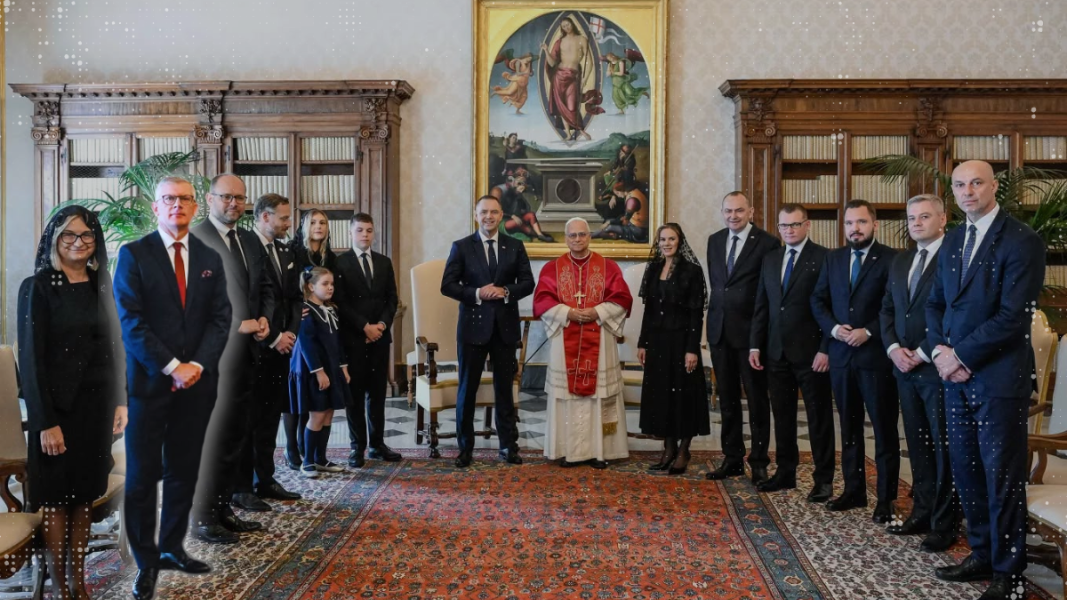
On September 5th, Pope Leo XIV received in audience the newly elected president of Poland, Karol Nawrocki, accompanied by an official delegation. Among the attendees was the Polish historian and journalist Sławomir Cenckiewicz, known for his defense of the Catholic tradition, who assured that he had raised the “injustice” of the restrictions imposed on the faithful linked to the liturgy prior to the Second Vatican Council.
As recounted by Cenckiewicz himself in a Facebook post, he took the opportunity not only to pay filial homage to the Pope, but also to dialogue with Cardinal Secretary of State Pietro Parolin and other prelates from the pontifical circle. “If you think that during my two visits to the Vatican and my private conversations with the prelates there was no mention of the Catholic Tradition and the injustice of Traditionis custodes, you are mistaken,” he stated emphatically.

The shadow of Traditionis custodes
In July 2021, Pope Francis published the motu proprio Traditionis custodes, with which he severely limited the use of the 1962 missal and the celebration of the sacraments according to the liturgical books prior to the Second Vatican Council. The measure generated strong discomfort among traditional communities and among numerous cardinals, who considered it an unfair treatment toward Catholics faithful to the Traditional Mass.
Figures such as Cardinals Raymond Burke, Gerhard Müller, Robert Sarah, and Kurt Koch have expressed their hope that Leo XIV will reverse these restrictions and restore free access to the traditional liturgy.
The visit to the Vatican
Cenckiewicz described his stay in the papal apartments as an unforgettable experience: “Remaining in the spaces where St. Pius X lived and worked, and contemplating masterpieces by El Greco, Dürer, and Caravaggio was a great grace. Deo gratias!”, he wrote on his social media.
However, beyond the personal emotion, the historian emphasized the importance of reminding the Church’s leaders of the suffering caused by the implementation of Traditionis custodes. His intervention, in the full context of a change in pontificate, reflects the expectation that Leo XIV may correct what many consider a policy of exclusion against Catholics linked to the traditional liturgy.
Cenckiewicz’s voice, on behalf of many faithful who feel marginalized, highlights that the issue has not disappeared. On the contrary, the Latin Mass remains a central topic of debate, with eyes on Leo XIV and his ability to listen to the requests of those who demand justice for the Tradition.