


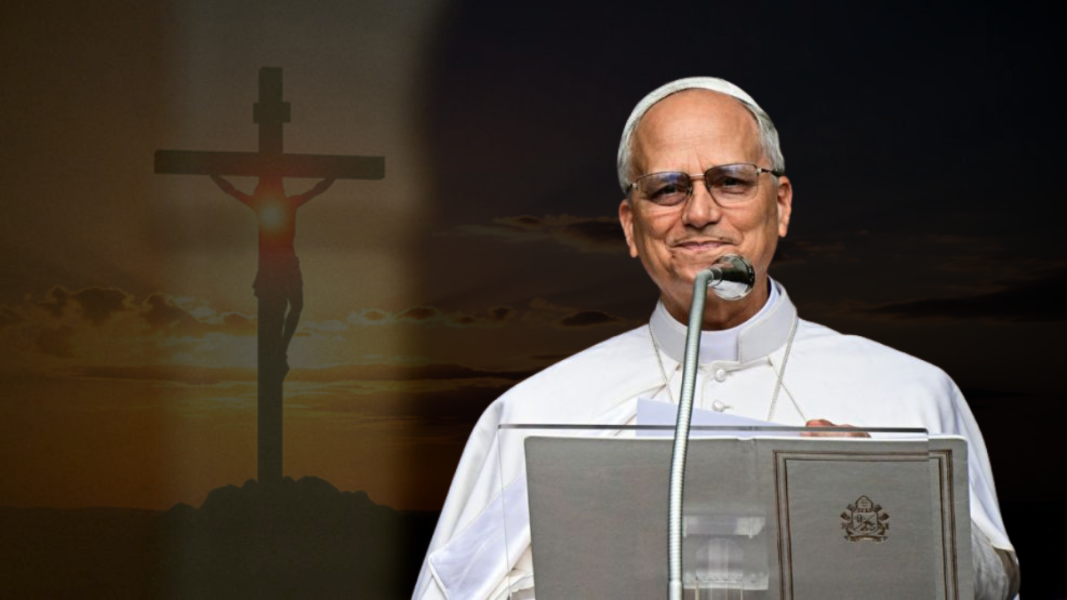
In the general audience this Wednesday, Pope Leo XIV continued the cycle of catechesis on the Jubilee 2025: Jesus Christ, our hope, centering his reflection on the mystery of the death of Jesus on the cross. The Pontiff highlighted the profound meaning of Christ’s final cry before expiring, a clamor that encloses pain, abandonment, faith, and surrender. As he explained, that cry was not one of desperation, but of radical trust in the Father, and it constitutes for Christians a school of hope amid trial.
Cycle of Catechesis – Jubilee 2025. Jesus Christ our hope. III. The Easter of Jesus. 6. The death. «Jesus, giving a loud cry, expired» (Mk 15:37)
Dear brothers and sisters:
Good morning and thank you for your presence, a beautiful witness!
Today we contemplate the summit of Jesus’ life in this world: his death on the cross. The Gospels narrate a very valuable detail, which deserves to be contemplated with the intelligence of faith. On the cross, Jesus does not die in silence. He does not fade away slowly, like a light that is consumed, but rather leaves life with a cry: «Jesus, giving a loud cry, expired» (Mk 15:37). That cry contains everything: pain, abandonment, faith, surrender. It is not only the voice of a body that gives way, but the ultimate sign of a life that is donated.
Jesus’ cry is preceded by a question, one of the most heart-wrenching that can be uttered: «My God, my God, why have you forsaken me?». It is the first verse of Psalm 22, but on Jesus’ lips it acquires a unique weight. The Son, who always lived in intimate communion with the Father, now experiences silence, absence, the abyss. It is not a crisis of faith, but the final stage of a love that surrenders to the end. Jesus’ cry is not desperation, but sincerity, truth taken to the limit, trust that endures even when everything is silent.
At that moment, the sky darkens and the veil of the temple is torn (cf. Mk 15:33.38). It is as if creation itself participates in that pain, and at the same time reveals something new: God no longer dwells behind a veil, his face is now fully visible in the Crucified One. It is there, in that torn man, where the greatest love is manifested. It is there where we can recognize a God who does not remain distant, but who penetrates to the depths of our pain.
The centurion, a pagan, understands it. Not because he heard a discourse, but because he saw Jesus die in that way: «Truly this man was the Son of God!» (Mk 15:39). It is the first profession of faith after Jesus’ death. It is the fruit of a cry that was not lost in the wind, but touched a heart. Sometimes, what we cannot express with words we manifest with the voice. When the heart is full, it cries out. And this is not always a sign of weakness; it can be a profound act of humanity.
We are accustomed to thinking of the cry as something disordered, which must be repressed. The Gospel gives immense value to our cry, reminding us that it can be invocation, protest, desire, surrender. It can even be the extreme form of prayer, when we no longer have words. In that cry, Jesus put everything he had left: all his love, all his hope.
Yes, because there is also hope in the cry: a hope that does not resign itself. We cry out when we believe that someone can hear. We cry out not out of desperation, but out of desire. Jesus did not cry out against the Father, but toward Him. Even in silence, he was convinced that the Father was there. And thus he showed us that our hope can cry out, even when everything seems lost.
Crying out then becomes a spiritual gesture. It is not only the first act of our life—when we are born crying—it is also a way of remaining alive. We cry out when we suffer, but also when we love, call, invoke. Crying out is saying that we exist, that we do not want to fade away in silence, that we still have something to offer.
In the journey of life, there are moments when keeping everything inside can slowly consume us. Jesus teaches us not to fear the cry, as long as it is sincere, humble, and oriented toward the Father. A cry is never useless if it is born of love. And it is never ignored if it is surrendered to God. It is a way to not yield to cynicism, to continue believing that another world is possible.
Dear brothers and sisters, let us also learn this from the Lord Jesus: let us learn the cry of hope when the hour of extreme trial arrives. Not to wound, but to commend ourselves. Not to cry out against someone, but to open the heart. If our cry is true, it can be the threshold of a new light, of a new birth. As happened with Jesus: when everything seemed finished, in reality salvation was about to begin. If it is manifested with the confidence and freedom of the children of God, the suffering voice of our humanity, united to the voice of Christ, can become a source of hope for us and for those around us.