


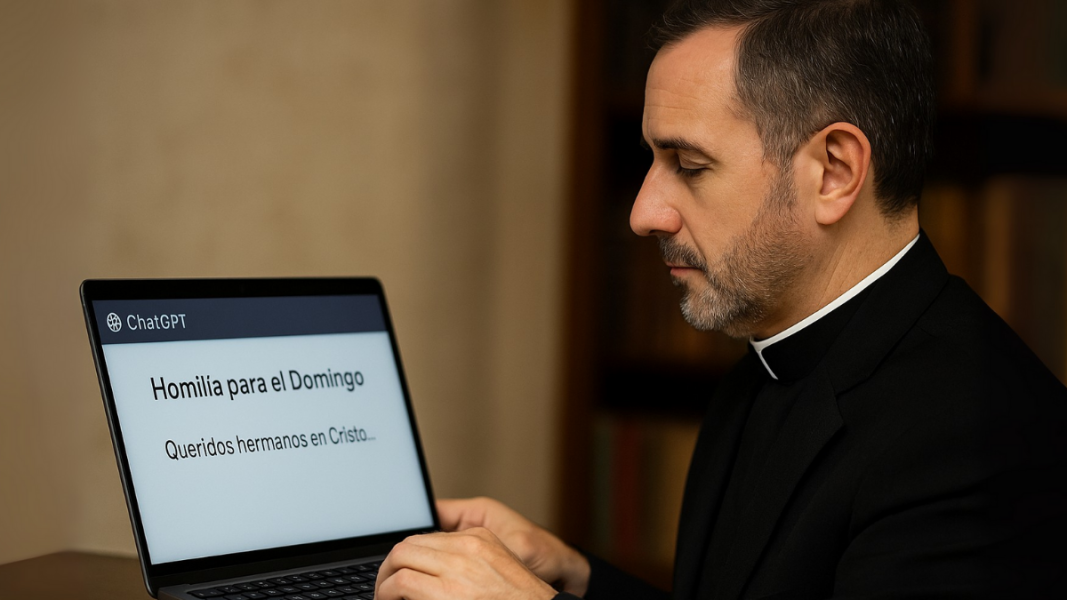
In Santiago de Chile, about 60 priests participated on September 5 in a conference that posed a provocative question: is it legitimate to rely on artificial intelligence to prepare homilies?
The event, organized by Archbishop Fernando Chomali in the Pope Francis Hall of the Archdiocese, was led by Andrés Vergara, a civil engineer from the Pontificia Universidad Católica de Chile, who introduced the presbyters to the world of generative and agentic AI. As he explained to Aciprensa, the first is limited to producing texts, images, or audios; while the second can execute autonomous functions.
ChatGPT in the Preparation of Homilies
During the conference, Vergara showed practical examples of how ChatGPT can assist in drafting homilies, suggesting structures, biblical quotes, or preaching ideas. He also presented tools like Perplexity.com for academic searches, ChatGPT’s Research Agent for deeper investigations, and Google’s NotebookLM, which allows summarizing and organizing extensive documents.
The proposal generated questions among the priests about copyright, formative quality, and the risks of technological dependence in pastoral life.
Prudence and Discernment in the Face of AI
Vergara recommended that attendees use these tools experimentally and in specific cases: «It’s about learning through practice, not replacing personal discernment or spiritual experience,» he told Aciprensa.
He also warned about the psychological risks of excessive use and emphasized that AI must always be subordinate to the evangelizing mission. Platforms like YouTube and AI itself can serve as pedagogical support, but they require discernment to avoid falling into automatisms.
Evangelize, Humanize, and Generate Fraternity
At the end of the meeting, Cardinal Fernando Chomali thanked those present and placed the debate in a broader perspective: «The more this advances, the more important our mission to evangelize, humanize the world, and generate fraternity will be.»
The Archdiocese of Santiago thus seeks to open a space for discernment on artificial intelligence, at a time when technology promises to help the Church in its pastoral tasks, but also demands remembering that no machine can replace the experience of faith or preaching born from a heart configured with Christ.